Base visitor class for AST traversal 더 자세히 ...
#include <visitor.hpp>
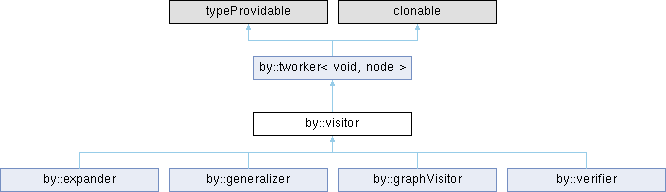
Public 멤버 함수 | |
| visitor (nbool isReturnable) | |
| void | setReturnable (nbool isReturnable) |
| nbool | isReturnable () const |
| virtual void | visit (const visitInfo &i, node &me) |
| virtual nbool | onVisit (const visitInfo &i, node &me, nbool alreadyVisited) |
| virtual void | onLeave (const visitInfo &i, node &me, nbool alreadyVisited) |
| virtual void | onTraverse (const visitInfo &i, node &me) |
| virtual void | onTraverse (const visitInfo &i, asExpr &a) |
| virtual void | onTraverse (const visitInfo &i, assignExpr &a) |
| virtual void | onTraverse (const visitInfo &i, blockExpr &b) |
| virtual void | onTraverse (const visitInfo &i, defVarExpr &d) |
| virtual void | onTraverse (const visitInfo &i, FBOExpr &f) |
| virtual void | onTraverse (const visitInfo &i, getExpr &e) |
| virtual void | onTraverse (const visitInfo &i, retExpr &b) |
| virtual void | onTraverse (const visitInfo &i, evalExpr &e) |
| virtual void | onTraverse (evalExpr &e, node &subject) |
| virtual void | onTraverse (const visitInfo &i, func &f) |
| virtual void | onTraverse (const visitInfo &i, frame &f) |
| virtual void | onTraverse (const visitInfo &i, forExpr &f) |
| virtual void | onTraverse (const visitInfo &i, retStateExpr &r) |
| virtual void | onTraverse (const visitInfo &i, ifExpr &f) |
| virtual void | onTraverse (const visitInfo &i, whileExpr &w) |
| virtual void | onTraverse (const visitInfo &i, defArrayExpr &d) |
| virtual void | onTraverse (const visitInfo &i, defNestedFuncExpr &e) |
| virtual void | onTraverse (const visitInfo &i, genericOrigin &g) |
| virtual void | onTraverse (const visitInfo &i, obj &o) |
 by::tworker< void, node >(으)로부터 상속된 Public 멤버 함수 by::tworker< void, node >(으)로부터 상속된 Public 멤버 함수 | |
| tworker (const errReport &rpt) | |
| errReport & | getReport () |
| const errReport & | getReport () const BY_CONST_FUNC(getReport()) me &setReport(errReport &rpt) |
| me & | setFlag (nint newFlag) |
| me & | addFlag (nint flag) |
| me & | delFlag (nint clear) |
| nbool | isFlag (nint flag) const |
| nint | getFlag () const |
| me & | setTask (const node &root) |
| me & | setTask (const node *it) BY_SIDE_FUNC(it |
| node * | getTask () |
| const node * | getTask () const BY_CONST_FUNC(getTask()) virtual void rel() |
| void | work () |
| const area & | getArea () const BY_CONST_FUNC(_getArea()) nbool isOk() const |
| by::typeProvidable(으)로부터 상속된 Public 멤버 함수 | |
| nbool | operator== (const me &rhs) const |
| nbool | operator!= (const me &rhs) const |
| virtual const type & | getType () const =0 |
| nbool | isSub (const type &it) const |
| nbool | isSub (const type *it) const BY_SIDE_FUNC(isSub) |
| nbool | isSub (const me &it) const |
| nbool | isSub (const me *it) const BY_SIDE_FUNC(isSub) |
| nbool | isSuper (const type &it) const |
| nbool | isSuper (const type *it) const BY_SIDE_FUNC(isSuper) |
| nbool | isSuper (const me &it) const |
| nbool | isSuper (const me *it) const BY_SIDE_FUNC(isSuper) |
| template<typename T > | |
| nint | isSub () const |
| template<typename T > | |
| nint | isSuper () const |
| template<typename T > | |
| T * | cast () |
| template<typename T > | |
| const T * | cast () const BY_CONST_FUNC(cast< T >()) virtual void *cast(const type &to) |
| Safe cast to target type using type hierarchy information | |
| const void * | cast (const type &to) const BY_CONST_FUNC(cast(to)) void *cast(const type *it) BY_SIDE_FUNC(cast) |
| by::clonable(으)로부터 상속된 Public 멤버 함수 | |
| virtual me * | clone () const =0 |
| virtual me * | cloneDeep () const |
| virtual void | onCloneDeep (const me &from) |
Protected 멤버 함수 | |
| void | _onWork () override |
| void | _prepare () override |
| Protected virtual method for preparation before starting the work. | |
| by::tworker< void, node >(으)로부터 상속된 Protected 멤버 함수 | |
| void | _report (baseErr *e) |
| virtual void | _onEndWork () |
| Protected virtual method called after the work is completed. | |
| area & | _getArea () |
| void | _onEndErrReport (const errReport &rpt) const |
추가로 상속된 멤버들 | |
| by::tworker< void, node >(으)로부터 상속된 Public 타입 | |
| enum | logFlag |
| by::tworker< void, node >(으)로부터 상속된 Public 속성 | |
| me setTask | it |
| me setTask * | this |
상세한 설명
Base visitor class for AST traversal
Since byeol focuses on AST, visitor is used frequently. visitor is actively utilized to separate the traversal method from the actions taken when visiting node during traversal.
Traversal
Always follows preorder traversal. Changing to postorder traversal is not possible. visit() consists of 3 stages:
- Visit the currently found node (onVisit())
- Traverse next child nodes (onTraverse())
- Leave the currently found node (onLeave())
Downcasting Through accept
visitor has many virtual functions that represent visits to many concrete types like onVisit(T&). On the other hand, when searching in onTraverse, the node type is mainly used because it uses the tbicontainable interface through node's subs(). So somewhere the node type must be downcast to concrete types like nInt or defNestedFuncExpr. For this purpose, node's virtual function accept() is called. See the example:
When the virtual function accept() is called, it reversely calls visitor's visit() as a concrete type through *this. For this, all node-derived classes participating in visitation must override the virtual function accept(), and the VISIT macro is used to make this process easier. You will often see declarations like this:
If a node-derived class does not override accept(), onTraverse(node&) is used instead, which is sufficient for those cases.
Duplicate Visit Elimination
AST sometimes has mutual references between nodes. In this case, traversing without any exception handling revisits already visited nodes and enters an infinite loop. visitor owns a map called _visited. Through this, when visit() is called, it determines if it's an already visited node and provides exception handling. This visit history information is reset right before visitor starts visiting each time. If you want to enable revisiting, change the value with setReturnable(true).
멤버 함수 문서화
◆ _onWork()
|
overrideprotectedvirtual |
◆ _prepare()
|
overrideprotectedvirtual |
Protected virtual method for preparation before starting the work.
This hook allows derived classes to perform any necessary setup or initialization before _onWork() is invoked.
by::tworker< void, node >(으)로부터 재구현되었습니다.
◆ setReturnable()
| void by::visitor::setReturnable | ( | nbool | isReturnable | ) |
if you set the visitor as returnable, nodes you have already been visited, will be visited again if it's refered by different nodes. in default, this value is false.
이 클래스에 대한 문서화 페이지는 다음의 파일로부터 생성되었습니다.:
- /home/runner/work/byeol/byeol/module/core/worker/visitor/visitor.hpp