Base class for all AST nodes in the byeol language 더 자세히 ...
#include <node.hpp>
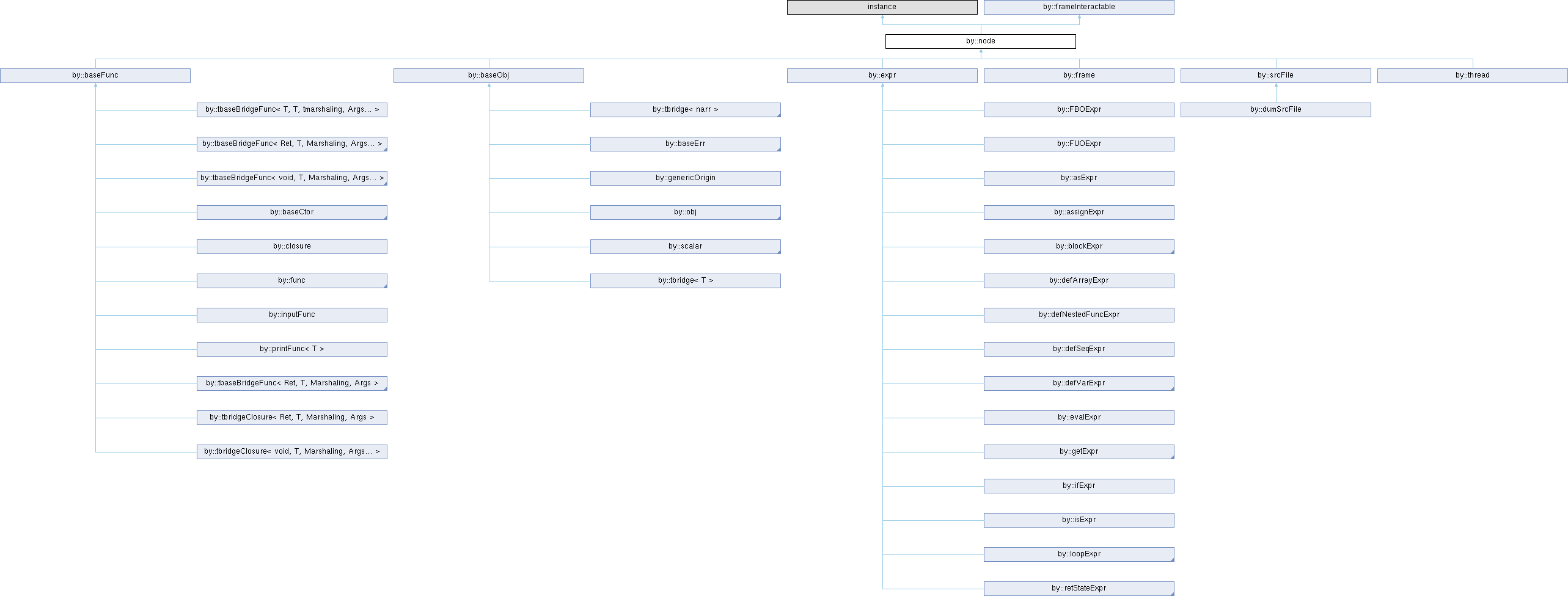
Public 멤버 함수 | |
| me & | operator[] (const std::string &name) |
| const me & | operator[] (const std::string &name) const BY_CONST_FUNC(operator[](name)) |
| me & | operator[] (const std::string *it) |
| const me & | operator[] (const std::string *it) const BY_CONST_FUNC(operator[](it)) |
| me & | operator[] (const nchar *name) |
| const me & | operator[] (const nchar *name) const BY_CONST_FUNC(operator[](name)) |
| nbool | in (const node &elem) const |
| nbool | in (const node *elem) const |
| virtual scope & | subs ()=0 |
| const scope & | subs () const BY_CONST_FUNC(subs()) virtual tstr< nbicontainer > mySubs() const |
| Returns a tstr to a container of immediate sub-nodes (excluding inherited or chained ones). | |
| const node * | promote (const node &it) const |
| const node * | promote (const node *it) const BY_SIDE_FUNC(promote) |
| template<typename T > | |
| T * | sub (std::function< nbool(const std::string &, const T &)> l) |
| template<typename T > | |
| const T * | sub (std::function< nbool(const std::string &, const T &)> l) const BY_CONST_FUNC(sub< T >(l)) template< typename T |
| template<typename T = me> | |
| const T * | sub () const BY_CONST_FUNC(sub< T >()) template< typename T |
| template<typename T = me> | |
| T * | sub (const std::string *it) BY_SIDE_FUNC(sub) |
| template<typename T = me> | |
| const T * | sub (const std::string &name) const BY_CONST_FUNC(sub< T >(name)) template< typename T |
| template<typename T = me> | |
| T * | sub (const std::string *name, const args &a) BY_SIDE_FUNC(name |
| template<typename T = me> | |
| const T * | sub (const std::string &name, const args &a) const BY_CONST_FUNC(sub< T >(name |
| template<typename T = me> | |
| const T a const T * | sub (const std::string *name, const args &a) const BY_CONST_FUNC(sub< T >(name |
| template<typename T > | |
| const T a const T a tnarr< T, strTactic > | subAll (std::function< nbool(const std::string &, const T &)> l) const |
| template<typename T = me> | |
| tnarr< T, strTactic > | subAll () const |
| template<typename T = me> | |
| tpriorities< T > | subAll (const std::string &name) const |
| template<typename T = me> | |
| tpriorities< T > | subAll (const std::string *it) const BY_SIDE_FUNC(subAll< T >) template< typename T |
| template<typename T = me> | |
| tpriorities< T > | subAll (const std::string &name, const args &a) const |
| template<typename T = me> | |
| tpriorities< T > | subAll (const std::string *name, const args *a) const BY_SIDE_FUNC(name |
| tpriorities< T > subAll< T > | tpriorities ()) |
| template<typename T = me> | |
| tpriorities< T > | subAll (const std::string *name, const args &a) const BY_SIDE_FUNC(name |
| tpriorities< T > subAll< T > | tpriorities ()) |
| bool | canEval (const args &a) const |
| virtual priorType | prioritize (const args &a) const =0 |
| priorType | prioritize (const args *it) const BY_SIDE_FUNC(it |
| virtual str | eval (const args &a)=0 |
| str | eval (const args *it) BY_SIDE_FUNC(eval) |
| str | eval (const std::string &name, const args &a) |
| str | eval (const std::string &name, const args *a) BY_SIDE_FUNC(a |
| str | eval (name, a) |
| str | str ()) |
| str | eval (const std::string *name, const args &a) BY_SIDE_FUNC(name |
| str eval | str ()) |
| str | eval (const std::string *name, const args *a) BY_SIDE_FUNC(name &&a |
| str eval | str ()) |
| str | eval (const std::string &name) |
| str | eval (const std::string *it) BY_SIDE_FUNC(eval) |
| str | eval () |
| virtual void | rel () |
| template<typename T > | |
| nbool | is () const |
| nbool | is (const typeProvidable &to) const |
| nbool | is (const typeProvidable *it) const BY_SIDE_FUNC(is) |
| nbool | is (const type &to) const |
| nbool | is (const type *it) const BY_SIDE_FUNC(is) |
| template<typename T > | |
| tstr< T > | as () const |
| str | as (const typeProvidable &to) const |
| str | as (const typeProvidable *it) const BY_SIDE_FUNC(as) |
| str | as (const type &to) const |
| str | as (const type *it) const BY_SIDE_FUNC(as) |
| template<typename T > | |
| nbool | isImpli () const |
| virtual nbool | isImpli (const type &to) const |
| nbool | isImpli (const typeProvidable &to) const |
| nbool | isImpli (const typeProvidable *it) const BY_SIDE_FUNC(isImpli) |
| template<typename T > | |
| tstr< T > | asImpli () const |
| virtual str | asImpli (const type &to) const |
| str | asImpli (const typeProvidable &to) const |
| str | asImpli (const typeProvidable *it) const BY_SIDE_FUNC(asImpli) |
| virtual const src & | getSrc () const |
| virtual nbool | isComplete () const |
| virtual str | infer () const |
| virtual void | accept (const visitInfo &i, visitor &v) |
| void | inFrame (const bicontainable *args) const override |
| void | outFrame () const override |
| virtual const modifier & | getModifier () const |
| virtual void | inFrame (const bicontainable *args) const=0 |
| void | inFrame () const |
| virtual void | outFrame () const=0 |
 by::instance(으)로부터 상속된 Public 멤버 함수 by::instance(으)로부터 상속된 Public 멤버 함수 | |
| instance (id newId) | |
| instance (const me &rhs) | |
| me & | operator= (const me &rhs)=default |
| void * | operator new (size_t sz) noexcept |
| void | operator delete (void *pt, size_t sz) noexcept |
| virtual id | getId () const |
| virtual nbool | isHeap () const |
| Checks if this instance is allocated on the heap. | |
| const life * | getBindTag () const |
| Returns a pointer to the associated life object for reference counting. | |
| by::typeProvidable(으)로부터 상속된 Public 멤버 함수 | |
| nbool | operator== (const me &rhs) const |
| nbool | operator!= (const me &rhs) const |
| virtual const type & | getType () const =0 |
| nbool | isSub (const type &it) const |
| nbool | isSub (const type *it) const BY_SIDE_FUNC(isSub) |
| nbool | isSub (const me &it) const |
| nbool | isSub (const me *it) const BY_SIDE_FUNC(isSub) |
| nbool | isSuper (const type &it) const |
| nbool | isSuper (const type *it) const BY_SIDE_FUNC(isSuper) |
| nbool | isSuper (const me &it) const |
| nbool | isSuper (const me *it) const BY_SIDE_FUNC(isSuper) |
| template<typename T > | |
| nint | isSub () const |
| template<typename T > | |
| nint | isSuper () const |
| template<typename T > | |
| T * | cast () |
| template<typename T > | |
| const T * | cast () const BY_CONST_FUNC(cast< T >()) virtual void *cast(const type &to) |
| Safe cast to target type using type hierarchy information | |
| const void * | cast (const type &to) const BY_CONST_FUNC(cast(to)) void *cast(const type *it) BY_SIDE_FUNC(cast) |
| by::clonable(으)로부터 상속된 Public 멤버 함수 | |
| virtual me * | clone () const =0 |
| virtual me * | cloneDeep () const |
| virtual void | onCloneDeep (const me &from) |
| by::frameInteractable(으)로부터 상속된 Public 멤버 함수 | |
| void | inFrame () const |
Public 속성 | |
| T sub | name |
| T sub | nullptr |
| tpriorities< T > subAll< T > | name |
| priorType prioritize | it |
| priorType prioritize | NO_MATCH |
| str eval | name |
Protected 멤버 함수 | |
| virtual str | _onEvalSub (node &sub, const args &a) |
| Protected virtual method for evaluating a sub-node. | |
| virtual void | _setSrc (const src &s) |
| void | _setSrc (const src *it) BY_SIDE_FUNC(_setSrc) |
| by::instance(으)로부터 상속된 Protected 멤버 함수 | |
| nbool | _setId (id new1) |
Friends | |
| class | coreInternal |
추가로 상속된 멤버들 | |
| by::instance(으)로부터 상속된 정적 Public 멤버 함수 | |
| static vault & | getVault () |
| by::instance(으)로부터 상속된 정적 Protected 멤버 함수 | |
| static instancer * | _getMgr () |
상세한 설명
Base class for all AST nodes in the byeol language
The most fundamental class in the core module. Unlike traditional AST (Abstract Syntax Tree) implementations, byeol executes programs while maintaining the AST structure, making it more akin to a Program Execution Tree (PET). Provides comprehensive APIs for AST structure manipulation, node evaluation, child node traversal, and type conversion.
Program Execution Tree
Unlike typical programming languages, byeol executes programs while maintaining the AST structure intact. In most languages, the AST is merely an intermediate representation of grammatical structure, but in byeol, the AST serves as the final executable output. Because execution is considered from the start, the class provides not only tree-based program structure representation but also APIs for type conversion and node evaluation.
Fundamental Base Class
Each node must be executable, so a node can be a function, an object, or an operator like +. The evaluation function is provided as eval(const args&) to execute and evaluate values.
Side Functions
As the core base class of the byeol project, node provides numerous side functions for various operations.
AST Traversal
Due to AST characteristics, a node can contain objects of other node-derived classes. Like a DOM tree, it uses the composition pattern, and various functions are provided to traverse this tree. In byeol, this tree is called scope and is map-based. Classes like blockExpr contain statement blocks as arrays while also being nodes. Therefore, the overall AST structure is a mix of maps and arrays. The scope uses each node's name as a key, where the parser defines appropriate names as keys when adding instances.
Common traversal functions: operator[], sub(), subs(), in(), subAll()
Handling Duplicate Symbols
Byeol doesn't allow duplicate symbols within the same scope, but this doesn't mean two pairs with the same key cannot exist. Functions with the same name but different parameter counts or types are different symbols. Simple string comparison cannot determine duplication, so the scope class is based on multimap rather than map.
Evaluation
A node can be a function, object, or expression. eval(const args&) returns the execution result of such nodes. (Byeol has no class concept; objects replace this role. Objects can be executed like functions, equivalent to calling a constructor.) The args object containing required arguments is passed to eval(). If the node's expected parameters differ in count or type from args, an empty str may be returned. Some node functions take a name parameter along with eval(), which finds child nodes matching the node's name and passes args to evaluate them—essentially dispatching a message.
Type Inference
infer() performs type inference. It doesn't return the exact runtime value but the type determined at verification stage. For example:
This creates an expression like 2 + 3.5 by putting nInt and nFlt objects into FBOExpr. Calling infer() yields nFlt due to type promotion (int + flt = flt). Type inference for an expression requires recursively calling type inference on child nodes, unlike getType() which returns immediately. The AST must be traversed to calculate type information. Note that type inference focuses on quickly determining types and doesn't compute values. In the example above, the nFlt value in infered contains the default value—use eval() for accurate values.
Type Conversion
Node provides as() for explicit type conversion and is() to check conversion possibility:
as() and is() provide various side functions, enabling generic functions:
This example is verbose for clarity. Real code uses WHEN for brevity. Rewriting foo():
Scripted vs Native Type Conversion
The as() and is() functions handle type conversion in the byeol language environment. For example, nInt is the C++ class representing byeol's int. It inherits from node because int can be an AST instance in byeol. Calling is<nFlt>() on nInt is allowed, but this doesn't mean nInt converts to nFlt in C++ code. In C++, implicit conversion is generally only allowed when nInt is a parent class of nFlt.
To check if nFlt is a kind of node, use the meta module's type conversion via cast(). The meta module manages native environment types in C++ code. Thus, two type conversion systems exist: one for native (C++) and one for script (byeol language):
The core module often implements the same concept separately for native and byeol runtime environments. Get familiar with this pattern. See ases and asable for type conversion flow details.
Implicit vs Explicit Conversion
Implicit conversion is provided via impliAs() and impliIs(). Rarely called directly by external code; mostly invoked by AST classes like expr and baseFunc. User-defined type conversions are naturally excluded from implicit conversion, hence the distinction.
Visitable Class
AST traversal occurs for various purposes, not just eval() but also for debugging output. To separate traversal methods from node processing, the visitor pattern must be applied to nodes. accept() is used by the visitor class, and each class header requires the VISIT macro. See visitor for details.
Frame Interaction
frame manages the currently executing scope and registered symbols. Since node forms the AST base, if a node is an object or function, it must register or unregister owned functions or properties with the frame. inFrame() and outFrame() handle this. See frame for details.
Message Priority
Byeol supports function overloading, so an object may have multiple functions with the same name but different parameters. Some functions match args exactly, while others may require type conversion. Node uses prioritize() to determine how well child nodes match given args. Derived node classes return EXACT_MATCH for precise matches and NO_MATCH otherwise. See tprior and priorType for detailed criteria and algorithms.
멤버 함수 문서화
◆ _onEvalSub()
Protected virtual method for evaluating a sub-node.
This method is a crucial part of the evaluation mechanism, allowing derived classes to define how a specific sub-node is evaluated within the context of the current node.
- 매개변수
-
sub The sub-node to be evaluated. a The arguments for evaluation.
- 반환값
- The result of the evaluation as a
strobject.
by::baseObj, by::genericOrigin에서 재구현되었습니다.
◆ infer()
getType() returns what it is. opposite to it, this returns what this class will represents after evaluation.
for example, the expr class has derived from this node class. and if an user call the funcs to get type of it, class 'ntype' of 'expr' will be returned. but if that user call the 'infer()' then the 'expr' object evaluate its terms and returns it as a node from the output. it could be an integer if it was addExpr and all terms are constructed with integers.
and also this func requires frames. means that you have to interact frame first before call this func.
- Remarks
- some derived class of node may require to call this function first by verifier. if you call this function without calling verifier previously will damage then process.
by::baseCtor, by::ctor, by::asExpr, by::assignExpr, by::blockExpr, by::defArrayExpr, by::defAssignExpr, by::defSeqExpr, by::defVarExpr, by::endExpr, by::evalExpr, by::FBOExpr, by::getExpr, by::ifExpr, by::isExpr, by::loopExpr, by::retExpr, by::genericOrigin에서 재구현되었습니다.
◆ inFrame() [1/2]
|
overridevirtual |
◆ inFrame() [2/2]
|
virtual |
◆ isComplete()
|
virtual |
returns whether this instance is complete or not. if some instance is incomplete, it means that it's not accessible on byeolang source codes.
by::origin에서 재구현되었습니다.
◆ outFrame() [1/2]
|
overridevirtual |
◆ outFrame() [2/2]
|
virtual |
◆ prioritize()
by::expr, by::retExpr에서 구현되었습니다.
◆ promote()
- 매개변수
-
r type to be promoted to this type. if a type is null, it means that there is no type specified. it's complete different to 'void' type.
- 반환값
- null if it's not relative between l & r.
◆ rel()
|
inlinevirtual |
Release all held resources and prepare for termination.
- Remarks
- Some classes won't be able to reinitialize after rel() is called.
by::autopod, by::blockExpr, by::pod, by::arr, by::nStr, by::frame, by::thread에서 재구현되었습니다.
◆ subAll()
| tpriorities< T > by::node::subAll | ( | const std::string * | it | ) | const |
finds subnodes of this node, allowing implicit conversion based on name and arguments.
- 매개변수
-
a if you pass this as a nullptr, the argument will be ignored and all names that are the same will be considered to meet the condition.
- 경고
- if you pass the argument as
args(), it will be considered to meet the condition only if there are no parameters and the names are the same, so the two have completely different meanings.
◆ subs()
Returns a tstr to a container of immediate sub-nodes (excluding inherited or chained ones).
This method provides direct access to the immediate children owned by this node, distinguishing them from children accessible via chained scopes or inheritance.
- 반환값
- A tstr to a container holding the immediate sub-nodes.
이 클래스에 대한 문서화 페이지는 다음의 파일로부터 생성되었습니다.:
- /home/runner/work/byeol/byeol/module/core/ast/node.hpp