Base class for error hierarchy 더 자세히 ...
#include <baseErr.hpp>
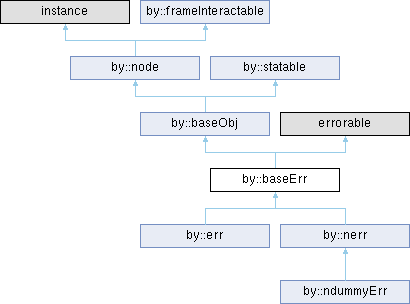
Public 멤버 함수 | |
| baseErr (errLv::level t) | |
| baseErr (const baseErr &rhs) | |
| me & | operator= (const me &rhs) |
| virtual nbool | operator== (const me &rhs) const =0 |
| nbool | operator!= (const me &rhs) const |
| const frames & | getFrames () const |
| void | logStack () const override |
| Log error with stack trace | |
| void | dump () const override |
| Dump object state for debugging | |
| errLv::level | getLv () const override |
| const std::string & | getMsg () const override |
| virtual errCode | getErrCode () const |
 by::baseObj(으)로부터 상속된 Public 멤버 함수 by::baseObj(으)로부터 상속된 Public 멤버 함수 | |
| str | eval (const args &a) override |
| scope & | subs () override |
| state | getState () const override |
| void | setState (state new1) override |
| priorType | prioritize (const args &a) const override |
| virtual const baseObj & | getOrigin () const |
| void | inFrame (const bicontainable *args) const override |
| void | outFrame () const override |
| const src & | getSrc () const override |
| virtual const node & | getSubPod () const |
| Retrieves a sub-pod represented as a node. | |
| virtual baseObj * | make () const |
| const modifier & | getModifier () const override |
| by::node(으)로부터 상속된 Public 멤버 함수 | |
| me & | operator[] (const std::string &name) |
| const me & | operator[] (const std::string &name) const BY_CONST_FUNC(operator[](name)) |
| me & | operator[] (const std::string *it) |
| const me & | operator[] (const std::string *it) const BY_CONST_FUNC(operator[](it)) |
| me & | operator[] (const nchar *name) |
| const me & | operator[] (const nchar *name) const BY_CONST_FUNC(operator[](name)) |
| nbool | in (const node &elem) const |
| nbool | in (const node *elem) const |
| const scope & | subs () const BY_CONST_FUNC(subs()) virtual tstr< nbicontainer > mySubs() const |
| Returns a tstr to a container of immediate sub-nodes (excluding inherited or chained ones). | |
| const node * | promote (const node &it) const |
| const node * | promote (const node *it) const BY_SIDE_FUNC(promote) |
| template<typename T > | |
| T * | sub (std::function< nbool(const std::string &, const T &)> l) |
| template<typename T > | |
| const T * | sub (std::function< nbool(const std::string &, const T &)> l) const BY_CONST_FUNC(sub< T >(l)) template< typename T |
| template<typename T = me> | |
| const T * | sub () const BY_CONST_FUNC(sub< T >()) template< typename T |
| template<typename T = me> | |
| T * | sub (const std::string *it) BY_SIDE_FUNC(sub) |
| template<typename T = me> | |
| const T * | sub (const std::string &name) const BY_CONST_FUNC(sub< T >(name)) template< typename T |
| template<typename T = me> | |
| T * | sub (const std::string *name, const args &a) BY_SIDE_FUNC(name |
| template<typename T = me> | |
| const T * | sub (const std::string &name, const args &a) const BY_CONST_FUNC(sub< T >(name |
| template<typename T = me> | |
| const T a const T * | sub (const std::string *name, const args &a) const BY_CONST_FUNC(sub< T >(name |
| template<typename T > | |
| const T a const T a tnarr< T, strTactic > | subAll (std::function< nbool(const std::string &, const T &)> l) const |
| template<typename T = me> | |
| tnarr< T, strTactic > | subAll () const |
| template<typename T = me> | |
| tpriorities< T > | subAll (const std::string &name) const |
| template<typename T = me> | |
| tpriorities< T > | subAll (const std::string *it) const BY_SIDE_FUNC(subAll< T >) template< typename T |
| template<typename T = me> | |
| tpriorities< T > | subAll (const std::string &name, const args &a) const |
| template<typename T = me> | |
| tpriorities< T > | subAll (const std::string *name, const args *a) const BY_SIDE_FUNC(name |
| tpriorities< T > subAll< T > | tpriorities ()) |
| template<typename T = me> | |
| tpriorities< T > | subAll (const std::string *name, const args &a) const BY_SIDE_FUNC(name |
| tpriorities< T > subAll< T > | tpriorities ()) |
| bool | canEval (const args &a) const |
| priorType | prioritize (const args *it) const BY_SIDE_FUNC(it |
| str | eval (const args *it) BY_SIDE_FUNC(eval) |
| str | eval (const std::string &name, const args &a) |
| str | eval (const std::string &name, const args *a) BY_SIDE_FUNC(a |
| str | eval (name, a) |
| str | str ()) |
| str | eval (const std::string *name, const args &a) BY_SIDE_FUNC(name |
| str eval | str ()) |
| str | eval (const std::string *name, const args *a) BY_SIDE_FUNC(name &&a |
| str eval | str ()) |
| str | eval (const std::string &name) |
| str | eval (const std::string *it) BY_SIDE_FUNC(eval) |
| str | eval () |
| virtual void | rel () |
| template<typename T > | |
| nbool | is () const |
| nbool | is (const typeProvidable &to) const |
| nbool | is (const typeProvidable *it) const BY_SIDE_FUNC(is) |
| nbool | is (const type &to) const |
| nbool | is (const type *it) const BY_SIDE_FUNC(is) |
| template<typename T > | |
| tstr< T > | as () const |
| str | as (const typeProvidable &to) const |
| str | as (const typeProvidable *it) const BY_SIDE_FUNC(as) |
| str | as (const type &to) const |
| str | as (const type *it) const BY_SIDE_FUNC(as) |
| template<typename T > | |
| nbool | isImpli () const |
| virtual nbool | isImpli (const type &to) const |
| nbool | isImpli (const typeProvidable &to) const |
| nbool | isImpli (const typeProvidable *it) const BY_SIDE_FUNC(isImpli) |
| template<typename T > | |
| tstr< T > | asImpli () const |
| virtual str | asImpli (const type &to) const |
| str | asImpli (const typeProvidable &to) const |
| str | asImpli (const typeProvidable *it) const BY_SIDE_FUNC(asImpli) |
| virtual nbool | isComplete () const |
| virtual str | infer () const |
| virtual void | accept (const visitInfo &i, visitor &v) |
| void | inFrame (const bicontainable *args) const override |
| void | outFrame () const override |
| virtual void | inFrame (const bicontainable *args) const=0 |
| void | inFrame () const |
| virtual void | outFrame () const=0 |
| by::instance(으)로부터 상속된 Public 멤버 함수 | |
| instance (id newId) | |
| instance (const me &rhs) | |
| me & | operator= (const me &rhs)=default |
| void * | operator new (size_t sz) noexcept |
| void | operator delete (void *pt, size_t sz) noexcept |
| virtual id | getId () const |
| virtual nbool | isHeap () const |
| Checks if this instance is allocated on the heap. | |
| const life * | getBindTag () const |
| Returns a pointer to the associated life object for reference counting. | |
| by::typeProvidable(으)로부터 상속된 Public 멤버 함수 | |
| nbool | operator== (const me &rhs) const |
| nbool | operator!= (const me &rhs) const |
| virtual const type & | getType () const =0 |
| nbool | isSub (const type &it) const |
| nbool | isSub (const type *it) const BY_SIDE_FUNC(isSub) |
| nbool | isSub (const me &it) const |
| nbool | isSub (const me *it) const BY_SIDE_FUNC(isSub) |
| nbool | isSuper (const type &it) const |
| nbool | isSuper (const type *it) const BY_SIDE_FUNC(isSuper) |
| nbool | isSuper (const me &it) const |
| nbool | isSuper (const me *it) const BY_SIDE_FUNC(isSuper) |
| template<typename T > | |
| nint | isSub () const |
| template<typename T > | |
| nint | isSuper () const |
| template<typename T > | |
| T * | cast () |
| template<typename T > | |
| const T * | cast () const BY_CONST_FUNC(cast< T >()) virtual void *cast(const type &to) |
| Safe cast to target type using type hierarchy information | |
| const void * | cast (const type &to) const BY_CONST_FUNC(cast(to)) void *cast(const type *it) BY_SIDE_FUNC(cast) |
| by::clonable(으)로부터 상속된 Public 멤버 함수 | |
| virtual me * | clone () const =0 |
| virtual me * | cloneDeep () const |
| virtual void | onCloneDeep (const me &from) |
| by::frameInteractable(으)로부터 상속된 Public 멤버 함수 | |
| void | inFrame () const |
| by::errorable(으)로부터 상속된 Public 멤버 함수 | |
| virtual void | log () const =0 |
| Log error message | |
| void | dbgLog () const |
| Log error in debug mode only | |
| const std::string & | getLevelName () const |
| Get human-readable error level name | |
정적 Public 멤버 함수 | |
| static scope & | makeSubs () |
| by::instance(으)로부터 상속된 정적 Public 멤버 함수 | |
| static vault & | getVault () |
Friends | |
| template<typename T , nbool > | |
| struct | tmarshaling |
추가로 상속된 멤버들 | |
| by::node(으)로부터 상속된 Public 속성 | |
| T sub | name |
| T sub | nullptr |
| tpriorities< T > subAll< T > | name |
| priorType prioritize | it |
| priorType prioritize | NO_MATCH |
| str eval | name |
| by::baseObj(으)로부터 상속된 정적 Public 속성 | |
| static const std::string | COMMON_NAME = "@common" |
| static const std::string | EXPAND_NAME = "@expand" |
| by::baseObj(으)로부터 상속된 Protected 멤버 함수 | |
| baseObj ()=default | |
| Default constructor for baseObj. | |
| baseObj (const baseObj *org, nbool isScripted) | |
| Constructs a baseObj from an existing origin object. | |
| str | _onEvalSub (node &sub, const args &a) override |
| Protected virtual method for evaluating a sub-node. | |
| void | _setSrc (const src &s) override |
| virtual void | _inFrame (frame &fr, const bicontainable *args) const |
| Enters this object's frame into the current execution stack. | |
| virtual void | _setType (const mgdType &new1) |
| Sets the script type for this base object. | |
| virtual void | _setModifier (const modifier &mod) |
| virtual str | _onBeforeCtor () |
| Hook method called before the object's constructor is fully executed. | |
| by::node(으)로부터 상속된 Protected 멤버 함수 | |
| void | _setSrc (const src *it) BY_SIDE_FUNC(_setSrc) |
| by::instance(으)로부터 상속된 Protected 멤버 함수 | |
| nbool | _setId (id new1) |
| by::instance(으)로부터 상속된 정적 Protected 멤버 함수 | |
| static instancer * | _getMgr () |
| by::baseObj(으)로부터 상속된 Protected 속성 | |
| tstr< baseObj > | _org |
상세한 설명
Base class for error hierarchy
The base class of the byeol language err class hierarchy. Includes common logic and interfaces for error handling.
Error Concept vs Implementation Gap
Byeol's grammar distinguishes two types of errors. One is known error represented by ?, and the other is exception - cases where errors are returned without being specified as an errorable type. However, in implementation, both are completely identical error objects. Errors are only distinguished by their origin: nerr generated by parser or verifier in native environment, and err generated by byeol code.
err has Strong Reference to frames
Uses this frame to provide callstack information. As explained in frame, frame is created by baseObj during function calls. Later, frame is del()ed by frames, only losing strong references but not immediately deleted from heap. (In this project, it's extremely rare to directly new/delete on heap without reference counting via tstr from the memlite module.) Therefore, as long as err lives, the referenced frame data is also maintained.
- Remarks
- err is closely related to errReport. See it if curious.
nerr is Mainly Created by core_when
nerr is primarily created by core module's __core_when__. Code looks like this:
The above code means if stmt is nullptr, the IS_NUL error is added to the errReport object returned by getReport(), and the function terminates while returning blk.
Dumpable and Log
Logs use the clog module to log the error. Meanwhile, dump() exposes as much information as possible including callstack.
errCode
nerr is managed by errCode for management purposes. nerr is mainly generated by parser or verifier, which helps easily search detailed information by giving codes like Err2203 along with code 2203 when syntax errors occur. errCode also simply defines description strings as literal constants for reference.
멤버 함수 문서화
◆ dump()
|
overridevirtual |
Dump object state for debugging
by::dumpable를 구현.
◆ getLv()
|
overridevirtual |
by::errorable를 구현.
◆ getMsg()
|
overridevirtual |
by::errorable를 구현.
◆ logStack()
|
overridevirtual |
이 클래스에 대한 문서화 페이지는 다음의 파일로부터 생성되었습니다.:
- /home/runner/work/byeol/byeol/module/core/builtin/err/baseErr.hpp