Base class for all function types 더 자세히 ...
#include <baseFunc.hpp>
Public 멤버 함수 | |
| scope & | subs () override |
| priorType | prioritize (const args &a) const override |
| virtual params & | getParams () |
| const params & | getParams () const BY_CONST_FUNC(getParams()) |
| virtual const node * | getRet () const |
| const src & | getSrc () const override |
| const modifier & | getModifier () const override |
| virtual const baseObj & | getOrigin () const =0 |
 by::node(으)로부터 상속된 Public 멤버 함수 by::node(으)로부터 상속된 Public 멤버 함수 | |
| me & | operator[] (const std::string &name) |
| const me & | operator[] (const std::string &name) const BY_CONST_FUNC(operator[](name)) |
| me & | operator[] (const std::string *it) |
| const me & | operator[] (const std::string *it) const BY_CONST_FUNC(operator[](it)) |
| me & | operator[] (const nchar *name) |
| const me & | operator[] (const nchar *name) const BY_CONST_FUNC(operator[](name)) |
| nbool | in (const node &elem) const |
| nbool | in (const node *elem) const |
| const scope & | subs () const BY_CONST_FUNC(subs()) virtual tstr< nbicontainer > mySubs() const |
| Returns a tstr to a container of immediate sub-nodes (excluding inherited or chained ones). | |
| const node * | promote (const node &it) const |
| const node * | promote (const node *it) const BY_SIDE_FUNC(promote) |
| template<typename T > | |
| T * | sub (std::function< nbool(const std::string &, const T &)> l) |
| template<typename T > | |
| const T * | sub (std::function< nbool(const std::string &, const T &)> l) const BY_CONST_FUNC(sub< T >(l)) template< typename T |
| template<typename T = me> | |
| const T * | sub () const BY_CONST_FUNC(sub< T >()) template< typename T |
| template<typename T = me> | |
| T * | sub (const std::string *it) BY_SIDE_FUNC(sub) |
| template<typename T = me> | |
| const T * | sub (const std::string &name) const BY_CONST_FUNC(sub< T >(name)) template< typename T |
| template<typename T = me> | |
| T * | sub (const std::string *name, const args &a) BY_SIDE_FUNC(name |
| template<typename T = me> | |
| const T * | sub (const std::string &name, const args &a) const BY_CONST_FUNC(sub< T >(name |
| template<typename T = me> | |
| const T a const T * | sub (const std::string *name, const args &a) const BY_CONST_FUNC(sub< T >(name |
| template<typename T > | |
| const T a const T a tnarr< T, strTactic > | subAll (std::function< nbool(const std::string &, const T &)> l) const |
| template<typename T = me> | |
| tnarr< T, strTactic > | subAll () const |
| template<typename T = me> | |
| tpriorities< T > | subAll (const std::string &name) const |
| template<typename T = me> | |
| tpriorities< T > | subAll (const std::string *it) const BY_SIDE_FUNC(subAll< T >) template< typename T |
| template<typename T = me> | |
| tpriorities< T > | subAll (const std::string &name, const args &a) const |
| template<typename T = me> | |
| tpriorities< T > | subAll (const std::string *name, const args *a) const BY_SIDE_FUNC(name |
| tpriorities< T > subAll< T > | tpriorities ()) |
| template<typename T = me> | |
| tpriorities< T > | subAll (const std::string *name, const args &a) const BY_SIDE_FUNC(name |
| tpriorities< T > subAll< T > | tpriorities ()) |
| bool | canEval (const args &a) const |
| priorType | prioritize (const args *it) const BY_SIDE_FUNC(it |
| virtual str | eval (const args &a)=0 |
| str | eval (const args *it) BY_SIDE_FUNC(eval) |
| str | eval (const std::string &name, const args &a) |
| str | eval (const std::string &name, const args *a) BY_SIDE_FUNC(a |
| str | eval (name, a) |
| str | str ()) |
| str | eval (const std::string *name, const args &a) BY_SIDE_FUNC(name |
| str eval | str ()) |
| str | eval (const std::string *name, const args *a) BY_SIDE_FUNC(name &&a |
| str eval | str ()) |
| str | eval (const std::string &name) |
| str | eval (const std::string *it) BY_SIDE_FUNC(eval) |
| str | eval () |
| virtual void | rel () |
| template<typename T > | |
| nbool | is () const |
| nbool | is (const typeProvidable &to) const |
| nbool | is (const typeProvidable *it) const BY_SIDE_FUNC(is) |
| nbool | is (const type &to) const |
| nbool | is (const type *it) const BY_SIDE_FUNC(is) |
| template<typename T > | |
| tstr< T > | as () const |
| str | as (const typeProvidable &to) const |
| str | as (const typeProvidable *it) const BY_SIDE_FUNC(as) |
| str | as (const type &to) const |
| str | as (const type *it) const BY_SIDE_FUNC(as) |
| template<typename T > | |
| nbool | isImpli () const |
| virtual nbool | isImpli (const type &to) const |
| nbool | isImpli (const typeProvidable &to) const |
| nbool | isImpli (const typeProvidable *it) const BY_SIDE_FUNC(isImpli) |
| template<typename T > | |
| tstr< T > | asImpli () const |
| virtual str | asImpli (const type &to) const |
| str | asImpli (const typeProvidable &to) const |
| str | asImpli (const typeProvidable *it) const BY_SIDE_FUNC(asImpli) |
| virtual nbool | isComplete () const |
| virtual str | infer () const |
| virtual void | accept (const visitInfo &i, visitor &v) |
| void | inFrame (const bicontainable *args) const override |
| void | outFrame () const override |
| virtual void | inFrame (const bicontainable *args) const=0 |
| void | inFrame () const |
| virtual void | outFrame () const=0 |
| by::instance(으)로부터 상속된 Public 멤버 함수 | |
| instance (id newId) | |
| instance (const me &rhs) | |
| me & | operator= (const me &rhs)=default |
| void * | operator new (size_t sz) noexcept |
| void | operator delete (void *pt, size_t sz) noexcept |
| virtual id | getId () const |
| virtual nbool | isHeap () const |
| Checks if this instance is allocated on the heap. | |
| const life * | getBindTag () const |
| Returns a pointer to the associated life object for reference counting. | |
| by::typeProvidable(으)로부터 상속된 Public 멤버 함수 | |
| nbool | operator== (const me &rhs) const |
| nbool | operator!= (const me &rhs) const |
| virtual const type & | getType () const =0 |
| nbool | isSub (const type &it) const |
| nbool | isSub (const type *it) const BY_SIDE_FUNC(isSub) |
| nbool | isSub (const me &it) const |
| nbool | isSub (const me *it) const BY_SIDE_FUNC(isSub) |
| nbool | isSuper (const type &it) const |
| nbool | isSuper (const type *it) const BY_SIDE_FUNC(isSuper) |
| nbool | isSuper (const me &it) const |
| nbool | isSuper (const me *it) const BY_SIDE_FUNC(isSuper) |
| template<typename T > | |
| nint | isSub () const |
| template<typename T > | |
| nint | isSuper () const |
| template<typename T > | |
| T * | cast () |
| template<typename T > | |
| const T * | cast () const BY_CONST_FUNC(cast< T >()) virtual void *cast(const type &to) |
| Safe cast to target type using type hierarchy information | |
| const void * | cast (const type &to) const BY_CONST_FUNC(cast(to)) void *cast(const type *it) BY_SIDE_FUNC(cast) |
| by::clonable(으)로부터 상속된 Public 멤버 함수 | |
| virtual me * | clone () const =0 |
| virtual me * | cloneDeep () const |
| virtual void | onCloneDeep (const me &from) |
| by::frameInteractable(으)로부터 상속된 Public 멤버 함수 | |
| void | inFrame () const |
정적 Public 멤버 함수 | |
| static nbool | isFuncButNotClosure (const node &n) |
| Checks if the given node represents a function that is not a closure. | |
| static nbool | isFuncButNotClosure (const node *it) BY_SIDE_FUNC(isFuncButNotClosure) |
| by::instance(으)로부터 상속된 정적 Public 멤버 함수 | |
| static vault & | getVault () |
정적 Public 속성 | |
| static const std::string | ME = "me" |
Protected 멤버 함수 | |
| void | _setSrc (const src &newSrc) override |
| by::node(으)로부터 상속된 Protected 멤버 함수 | |
| virtual str | _onEvalSub (node &sub, const args &a) |
| Protected virtual method for evaluating a sub-node. | |
| void | _setSrc (const src *it) BY_SIDE_FUNC(_setSrc) |
| by::instance(으)로부터 상속된 Protected 멤버 함수 | |
| nbool | _setId (id new1) |
추가로 상속된 멤버들 | |
| by::node(으)로부터 상속된 Public 속성 | |
| T sub | name |
| T sub | nullptr |
| tpriorities< T > subAll< T > | name |
| priorType prioritize | it |
| priorType prioritize | NO_MATCH |
| str eval | name |
| by::instance(으)로부터 상속된 정적 Protected 멤버 함수 | |
| static instancer * | _getMgr () |
상세한 설명
Base class for all function types
Abstract base class providing common functionality for all function types including func, closure, and bridged functions like tbridgeFunc. Manages parameters, return types, modifier, and function execution semantics.
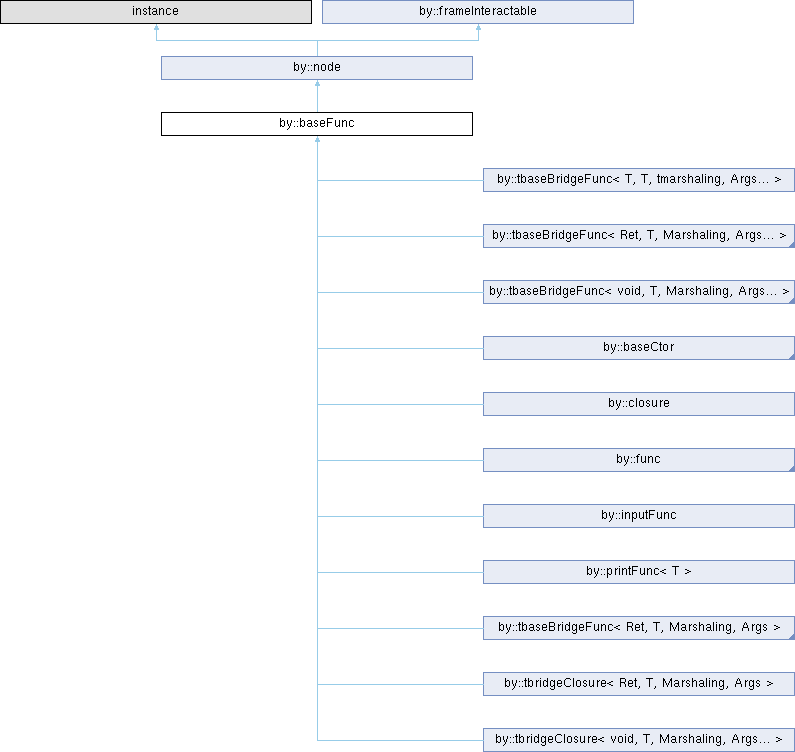
Function Hierarchy
The function class hierarchy in byeol:
- baseFunc - Abstract base for all functions
- func - User-defined functions with blockExpr bodies
- closure - Nested functions with captured scope
- tbridgeFunc - C++ native functions exposed to byeol
- ctor - Constructor functions
Parameters and Return
baseFunc manages:
- Parameters via
getParams()- function parameter list with names and types - Return type via
getRet()- the type this function returns when called - Modifiers via
getModifier()- access control (public/protected/override)
Note: getRet() returns the return type, not the function's own type. The function's type is obtained via getType() or infer().
Argument Prioritization
baseFunc implements sophisticated prioritize() logic to select the best matching function overload based on argument types. This enables function overloading in byeol.
멤버 함수 문서화
◆ _setSrc()
◆ getModifier()
◆ getParams()
- 반환값
- parameters of eval() func. parameter is just a type. and I don't care about the value of each parameters. that is the reason why I uses a ref to represents parameter.
I need the name and which types should be casted and binded from given arguments are matters.
by::closure에서 재구현되었습니다.
◆ getRet()
- 반환값
- node which has same type of the func. in byeol lang, even type is an object. that's why I return this as a node.
- Remarks
- please don't confuse this to node::infer(). evaluate means program just read the code and expand or calculate then replace it to the accurate another identifier or variable. so evalType of the func is just the func itself because there is nothing to calculate or eval. that's completely different to Return type of the function. if there is a evalExpr instance, and it takes the func and proper argument, then it can be evaluated and its evalType is the return type of the func.
by::closure에서 재구현되었습니다.
◆ getSrc()
◆ isFuncButNotClosure()
Checks if the given node represents a function that is not a closure.
- 매개변수
-
n The node to check.
- 반환값
- true if the node is a function but not a closure, false otherwise.
◆ prioritize()
◆ subs()
이 클래스에 대한 문서화 페이지는 다음의 파일로부터 생성되었습니다.:
- /home/runner/work/byeol/byeol/module/core/ast/baseFunc.hpp