Loading...
Searching...
No Matches
by::rootStela Class Reference
The compilation unit — the one node with no source form of its own. More...
#include <rootStela.hpp>
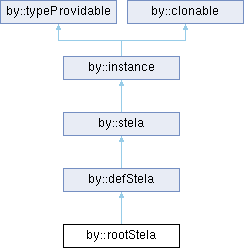
Inheritance diagram for by::rootStela:
Additional Inherited Members | |
 Public Member Functions inherited from by::stela Public Member Functions inherited from by::stela | |
| stela (std::initializer_list< me * > subs, const std::string &name="") | |
| Constructs a stela object with an optional name and an initializer list of child stela objects. | |
| stela (const me &rhs, const std::string &name="") | |
| stela (const std::string &name="") | |
| me & | operator[] (const std::string &name) |
| const me & | operator[] (const std::string &name) const BY_CONST_FUNC(operator[](name)) |
| me & | operator[] (const nchar *name) |
| const me & | operator[] (const nchar *name) const BY_CONST_FUNC(operator[](name)) |
| operator nbool () const | |
| Converts the stela object to a boolean, indicating its existence. | |
| me & | sub (const std::string &name) |
| me & | sub (const std::string *it) BY_SIDE_FUNC(it |
| const me &sub(nidx n) const BY_CONST_FUNC(sub(n)) nbool has(const std nbool | has (const std::string *it) const BY_SIDE_FUNC(has) |
| void | add (const stela &it) |
| Adds a stela object as a child. | |
| void | add (const stela *it) BY_SIDE_FUNC(add) |
| Adds a stela object as a child. | |
| void | add (std::initializer_list< stela * > subs) |
| Adds multiple stela objects from an initializer list as children. | |
| void | del (const stela &it) |
| void | del (const stela *it) BY_SIDE_FUNC(del) |
| void | del (const std::string &name) |
| void | del (const std::string *it) BY_SIDE_FUNC(del) |
| void | del (const nchar *name) |
| const std::string & | getPrefix () const |
The comment lines sitting above this node, # markers included. | |
| void | setPrefix (const std::string &newPrefix) |
| void | setPrefix (const nchar *newPrefix) |
| const std::string & | getPostfix () const |
The comment after this node on the same line, # marker included. | |
| void | setPostfix (const std::string &newPostfix) |
| void | setPostfix (const nchar *newPostfix) |
| const std::string & | getName () const |
| void | setName (const std::string &newName) |
| void | setName (const std::string *it) BY_SIDE_FUNC(setName) |
| void | setName (const nchar *newName) |
| ncnt | len () const |
| iterator | begin () |
| iterator | end () |
| virtual nint | asInt () const |
| Converts the stela object's value to an integer. | |
| virtual nchar | asChar () const |
| Converts the stela object's value to a character. | |
| virtual const std::string & | asStr () const |
| Converts the stela object's value to a string. | |
| virtual nbool | asBool () const |
| Converts the stela object's value to a boolean. | |
| virtual nbool | isExist () const |
| Checks if the stela object is considered "existent" (i.e., not a nulStela). | |
| virtual void | accept (const stelaVisitInfo &i, stelaVisitor &v) |
Dispatch entry for stelaVisitor. Base implementation calls v.visit(i, *this); subclasses override via the VISIT macro. | |
| Public Member Functions inherited from by::instance | |
| instance (id newId) | |
| instance (const me &rhs) | |
| me & | operator= (const me &rhs)=default |
| void * | operator new (size_t sz) noexcept |
| void | operator delete (void *pt, size_t sz) noexcept |
| virtual id | getId () const |
| virtual nbool | isHeap () const |
| Checks if this instance is allocated on the heap. | |
| const life * | getBindTag () const |
| Returns a pointer to the associated life object for reference counting. | |
| Public Member Functions inherited from by::typeProvidable | |
| nbool | operator== (const me &rhs) const |
| nbool | operator!= (const me &rhs) const |
| virtual const type & | getType () const =0 |
| nbool | isSub (const type &it) const |
| nbool | isSub (const type *it) const BY_SIDE_FUNC(isSub) |
| nbool | isSub (const me &it) const |
| nbool | isSub (const me *it) const BY_SIDE_FUNC(isSub) |
| nbool | isSuper (const type &it) const |
| nbool | isSuper (const type *it) const BY_SIDE_FUNC(isSuper) |
| nbool | isSuper (const me &it) const |
| nbool | isSuper (const me *it) const BY_SIDE_FUNC(isSuper) |
| template<typename T > | |
| nint | isSub () const |
| template<typename T > | |
| nint | isSuper () const |
| template<typename T > | |
| T * | cast () |
| template<typename T > | |
| const T * | cast () const BY_CONST_FUNC(cast< T >()) virtual void *cast(const type &to) |
| Safe cast to target type using type hierarchy information. | |
| const void * | cast (const type &to) const BY_CONST_FUNC(cast(to)) void *cast(const type *it) BY_SIDE_FUNC(cast) |
| Public Member Functions inherited from by::clonable | |
| virtual me * | clone () const =0 |
| virtual me * | cloneDeep () const |
| virtual void | onCloneDeep (const me &from) |
| Static Public Member Functions inherited from by::instance | |
| static vault & | getVault () |
| Public Attributes inherited from by::stela | |
| me sub | it |
| me sub * | this |
| const me &sub(const std::string &name) const BY_CONST_FUNC(sub(name)) const me &sub(const std const me | sub )(const nchar *name) const BY_CONST_FUNC(sub(name)) me &sub(nidx n) |
| Protected Member Functions inherited from by::instance | |
| nbool | _setId (id new1) |
| Static Protected Member Functions inherited from by::instance | |
| static instancer * | _getMgr () |
Detailed Description
The compilation unit — the one node with no source form of its own.
stela source has an implicit top level: statements at column 0 belong to the file, not to any def block. rootStela is that top level. It is a defStela in every respect but one: it is never written back out, because no def line produced it.
It exists so that "is this the root?" is a type, not a test. Anything taking a plain Stela used to answer that question by inspecting the traversal depth, which spread one document-shape rule across every such function and left the answer wrong for any subtree visited on its own.
stelaParser produces exactly one per parse.
The documentation for this class was generated from the following file:
- /home/runner/work/stela/stela/module/stela/ast/rootStela.hpp