Parser for stela configuration language. More...
#include <stelaParser.hpp>
Public Member Functions | |
| tstr< stela > | parse (const std::string &codes) |
| Parses the given string of stela code. | |
| tstr< stela > | parse (const nchar *codes) |
| Parses the given C-style string of stela code. | |
| tstr< stela > | parseFromFile (const std::string &path) |
| Parses stela code from the specified file path. | |
| tstr< stela > | parseFromFile (const nchar *path) |
| Parses stela code from the specified C-style file path. | |
| stelaTokenDispatcher & | getDispatcher () |
| std::vector< ncnt > & | getIndents () |
| nbool | isInit () const |
| template<typename T > | |
| void | setScan () |
| Sets the scanning mode for the lexer. | |
| void | rel () |
| int | pushState (int newState) |
| Pushes a new Flex scanner state onto the state stack. | |
| int | popState () |
| Pops a Flex scanner state from the state stack. | |
| nint | onScan (stelaParser &ps, ZZSTYPE *val, ZZLTYPE *loc, zzscan_t scanner, nbool &isBypass) override |
| Handles scanning for the lexer, overriding the base stelaTokenScanable behavior. | |
| nint | onTokenEndOfFile () |
| Handles the end-of-file token. | |
| nint | onTokenColon (nint tok) |
| Handles the colon token. | |
| nint | onTokenNewLine (nint tok) |
| Handles the newline token. | |
| nint | onTokenComma (nint tok) |
| Handles the comma token. | |
| nint | onIndent (ncnt col, nint tok) |
| Handles an increase in indentation. | |
| nint | onDedent (ncnt col, nint tok) |
| Handles a decrease in indentation. | |
| nint | onIgnoreIndent (nint tok) |
| Handles ignoring indentation (e.g., for inline blocks). | |
| nchar | onScanUnexpected (const nchar *token) |
| Handles an unexpected token encountered during scanning. | |
| void | onComment (const nchar *text) |
| Collects a piece of comment text the scanner would otherwise drop. | |
| void | onCommentBegin (const nchar *text, ncnt col) |
Collects the # or ## that opens a comment. | |
| nint | onTokenDef (nint tok) |
Marks the start of a def header so its comments can be held aside. | |
| nint | onTokenDefAssign (nint tok) |
| Holds aside the comments above an assignment until its value is complete. | |
| stela * | onDefBlock (stela *stmt) |
| stela * | onDefBlock (stela *blk, stela *stmt) |
| stela * | onDefBlock () |
| template<typename T > | |
| stela * | onPrimitive (const T &arg) |
| Creates a value stela node from a primitive value. | |
| verStela * | onVer (const std::string &version) |
| stela * | onInt (const std::string &repr) |
| Creates a number node from an integer literal, keeping its spelling. | |
| stela * | onFlt (const std::string &repr) |
| Creates a number node from a float literal, keeping its spelling. | |
| stela * | onDefProp (const std::string &name, stela &rhs) |
| stela * | onDefAssign (const std::string &name, stela *rhs) |
| stela * | onDefOrigin (const std::string &name, stela &blk) |
| stela * | onDefArray () |
| stela * | onDefArray (stela &elem) |
| stela * | onDefArray (stela &as, stela &elem) |
| stela * | onCompilationUnit (stela *blk) |
| void | onParseErr (const std::string &msg, const nchar *symbolName) |
| Handles a parse error, reporting the message and the symbol where the error occurred. | |
| void | report (const std::string &msg) |
| Reports a message, typically an error or warning, encountered during parsing. | |
| template<> | |
| stela * | onPrimitive (const nbool &arg) |
| template<> | |
| stela * | onPrimitive (const std::string &arg) |
| nint | onScan (stelaParser &ps, ZZSTYPE *val, ZZLTYPE *loc, zzscan_t scanner) |
| Default entry point for token scanning. | |
| virtual nint | onScan (stelaParser &ps, ZZSTYPE *yylval, ZZLTYPE *loc, zzscan_t yyscanner, nbool &isBypass)=0 |
| Pure virtual method for concrete token scanning implementations. | |
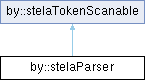
 Public Member Functions inherited from by::stelaTokenScanable Public Member Functions inherited from by::stelaTokenScanable | |
| nint | onScan (stelaParser &ps, ZZSTYPE *val, ZZLTYPE *loc, zzscan_t scanner) |
| Default entry point for token scanning. | |
Detailed Description
Parser for stela configuration language.
Entry point for the Stela parsing component. Specify scripts through parse() or parseFromFile(), and the parsed result is returned in Stela structure.
Similar structure to byeol parser
Since the stela language itself is a specialized language of byeol, the parser is also based on the byeol language parser. Since it's a less complex language than byeol, it's recommended to examine this parser code before looking at the core module.
- bison - stelaParser structure
Uses flex and bison, with flex named lowscanner and bison named lowparser. These low-level scanner and parser exist only within the parser component and are never exposed externally. When stelaParser::parse() executes, it runs lowscanner. lowscanner tokenizes and passes tokens to lowparser. When lowparser matches rules on received tokens, it passes events back to stelaParser. Therefore, stelaParser's functions starting with on are event handling functions that define how to create nodes and build the AST.
Indentation rule
Like the byeol language, stela applies the offside rule, making it very sensitive to indentation. Unlike typical languages, it must count whitespace after newlines. Once indentation is confirmed and determines which scope the code line belongs to, whitespace should be ignored afterward.
Member Function Documentation
◆ onComment()
Collects a piece of comment text the scanner would otherwise drop.
- Parameters
-
text The matched text, #and##markers included.
◆ onCommentBegin()
Collects the # or ## that opens a comment.
- Parameters
-
col The column it opens at. Later lines of a ##comment are kept relative to it, since the writer re-indents every line to its node's depth.
◆ onDedent()
Handles a decrease in indentation.
- Parameters
-
col The column count of the new indentation level. tok The token ID that triggered the dedentation.
- Returns
- The token ID for DEDENT.
◆ onIgnoreIndent()
Handles ignoring indentation (e.g., for inline blocks).
- Parameters
-
tok The token ID.
- Returns
- The token ID.
◆ onIndent()
Handles an increase in indentation.
- Parameters
-
col The column count of the new indentation level. tok The token ID that triggered the indentation.
- Returns
- The token ID for INDENT.
◆ onInt()
Creates a number node from an integer literal, keeping its spelling.
- Parameters
-
repr The literal as written, decimal or 0xhex. One wider than nint is reported as a parse error.
◆ onParseErr()
Handles a parse error, reporting the message and the symbol where the error occurred.
- Parameters
-
msg The error message. symbolName The name of the symbol causing the error.
◆ onPrimitive()
Creates a value stela node from a primitive value.
One node type per literal form, so the distinction the scanner already made survives into the AST. Numbers are the primary; every other form specializes below.
◆ onScan() [1/3]
| nint by::stelaTokenScanable::onScan | ( | stelaParser & | ps, |
| ZZSTYPE * | val, | ||
| ZZLTYPE * | loc, | ||
| zzscan_t | scanner ) |
Default entry point for token scanning.
This non-virtual method acts as a wrapper that internally dispatches to the pure virtual onScan method, which must be implemented by concrete scanner strategies.
- Parameters
-
ps The stelaParser instance. val The YYSTYPE value pointer for the token. loc The YYLTYPE location pointer for the token. scanner The Flex scanner instance.
- Returns
- The token ID.
◆ onScan() [2/3]
|
overridevirtual |
Handles scanning for the lexer, overriding the base stelaTokenScanable behavior.
- Parameters
-
ps The stelaParser instance. val The YYSTYPE value pointer for the token. loc The YYLTYPE location pointer for the token. scanner The Flex scanner instance. isBypass Flag indicating if indentation bypass is active.
- Returns
- The token ID.
Implements by::stelaTokenScanable.
◆ onScan() [3/3]
|
virtual |
Pure virtual method for concrete token scanning implementations.
- Parameters
-
ps The stelaParser instance. yylval The YYSTYPE value pointer for the token. loc The YYLTYPE location pointer for the token. yyscanner The Flex scanner instance. isBypass Flag indicating if indentation bypass is active.
- Returns
- The token ID.
Implements by::stelaTokenScanable.
◆ onScanUnexpected()
Handles an unexpected token encountered during scanning.
- Parameters
-
token The unexpected token string.
- Returns
- The token ID for an error.
◆ onTokenColon()
Handles the colon token.
- Parameters
-
tok The token ID of the colon.
- Returns
- The token ID.
◆ onTokenComma()
Handles the comma token.
- Parameters
-
tok The token ID of the comma.
- Returns
- The token ID.
◆ onTokenDef()
Marks the start of a def header so its comments can be held aside.
The defStela is not created until its whole block has reduced, by which time the pending comments belong to its first child instead.
◆ onTokenDefAssign()
Holds aside the comments above an assignment until its value is complete.
A value is not always created first: an array is created after its elements, and the first one would otherwise take the comment.
◆ onTokenEndOfFile()
| nint by::stelaParser::onTokenEndOfFile | ( | ) |
Handles the end-of-file token.
- Returns
- The token ID for end-of-file.
◆ onTokenNewLine()
Handles the newline token.
- Parameters
-
tok The token ID of the newline.
- Returns
- The token ID.
◆ parse() [1/2]
Parses the given C-style string of stela code.
- Parameters
-
codes The stela code as a C-style string.
- Returns
- A tstr to the parsed stela AST root object, or null on error.
◆ parse() [2/2]
Parses the given string of stela code.
- Parameters
-
codes The stela code as a string.
- Returns
- A tstr to the parsed stela AST root object, or null on error.
◆ parseFromFile() [1/2]
Parses stela code from the specified C-style file path.
- Parameters
-
path The path to the file containing stela code.
- Returns
- A tstr to the parsed stela AST root object, or null on error.
◆ parseFromFile() [2/2]
Parses stela code from the specified file path.
- Parameters
-
path The path to the file containing stela code.
- Returns
- A tstr to the parsed stela AST root object, or null on error.
◆ popState()
| int by::stelaParser::popState | ( | ) |
Pops a Flex scanner state from the state stack.
- Returns
- The previous state.
◆ pushState()
Pushes a new Flex scanner state onto the state stack.
- Parameters
-
newState The new state to push.
- Returns
- The new state.
◆ report()
Reports a message, typically an error or warning, encountered during parsing.
- Parameters
-
msg The message to report.
◆ setScan()
Sets the scanning mode for the lexer.
- Template Parameters
-
T The type of the scanner strategy (e.g., normalScan, indentScan).
The documentation for this class was generated from the following file:
- /home/runner/work/stela/stela/module/stela/parser/stelaParser.hpp