Base class for all managed instances in memlite system. More...
#include <instance.hpp>
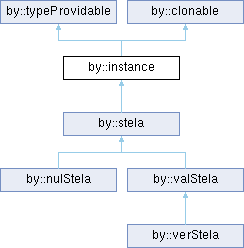
Classes | |
| class | vault |
Public Member Functions | |
| instance (id newId) | |
| instance (const me &rhs) | |
| me & | operator= (const me &rhs)=default |
| void * | operator new (size_t sz) noexcept |
| void | operator delete (void *pt, size_t sz) noexcept |
| virtual id | getId () const |
| virtual nbool | isHeap () const |
| Checks if this instance is allocated on the heap. | |
| const life * | getBindTag () const |
| Returns a pointer to the associated life object for reference counting. | |
 Public Member Functions inherited from by::typeProvidable Public Member Functions inherited from by::typeProvidable | |
| nbool | operator== (const me &rhs) const |
| nbool | operator!= (const me &rhs) const |
| virtual const type & | getType () const =0 |
| nbool | isSub (const type &it) const |
| nbool | isSub (const type *it) const BY_SIDE_FUNC(isSub) |
| nbool | isSub (const me &it) const |
| nbool | isSub (const me *it) const BY_SIDE_FUNC(isSub) |
| nbool | isSuper (const type &it) const |
| nbool | isSuper (const type *it) const BY_SIDE_FUNC(isSuper) |
| nbool | isSuper (const me &it) const |
| nbool | isSuper (const me *it) const BY_SIDE_FUNC(isSuper) |
| template<typename T > | |
| nint | isSub () const |
| template<typename T > | |
| nint | isSuper () const |
| template<typename T > | |
| T * | cast () |
| template<typename T > | |
| const T * | cast () const BY_CONST_FUNC(cast< T >()) virtual void *cast(const type &to) |
| Safe cast to target type using type hierarchy information. | |
| const void * | cast (const type &to) const BY_CONST_FUNC(cast(to)) void *cast(const type *it) BY_SIDE_FUNC(cast) |
| Public Member Functions inherited from by::clonable | |
| virtual me * | clone () const =0 |
| virtual me * | cloneDeep () const |
| virtual void | onCloneDeep (const me &from) |
Static Public Member Functions | |
| static vault & | getVault () |
Protected Member Functions | |
| nbool | _setId (id new1) |
Static Protected Member Functions | |
| static instancer * | _getMgr () |
Friends | |
| class | memliteInternal |
Detailed Description
Base class for all managed instances in memlite system.
Objects managed by memlite's custom memory pool must inherit from instance. Only by inheriting instance can objects be referenced through binder as weak or strong pointers. Instances are identified through id.
ID assignment algorithm
The weakest part of memlite is this id assignment algorithm. Instance creation is done by instancer which manages the memory pool. The instancer pushes the instance address and id to a map in the internal vault class. When instance::operator new() is called, it internally accesses vault using code like map[this] to retrieve the id value.
While seemingly fine, it has many disadvantages:
- Accessing vault during constructor phase is not truly safe
- It's slow
The initial implementation used only vector managed as FIFO, but when creating other objects inside a constructor, the order of added ids no longer follows FIFO, causing ID混乱 issues.
- Remarks
- Performance importance The most frequent operation in byeol is creating objects while assigning ids or performing binding. This needs improvement when time permits.
Member Function Documentation
◆ getBindTag()
Returns a pointer to the associated life object for reference counting.
The life object is used by binder and watcher to manage the instance's lifecycle.
- Returns
- A const pointer to the
lifeobject, or nullptr if none is associated.
◆ isHeap()
Checks if this instance is allocated on the heap.
- Returns
- true if the instance is heap-allocated, false otherwise.
- Note
- This check is typically related to how the instance is managed by the memory pool.
The documentation for this class was generated from the following file:
- /home/runner/work/stela/stela/module/memlite/interface/instance.hpp