Base class for all expressions. More...
#include <expr.hpp>
Classes | |
| class | exprType |
| Type information for expression nodes More... | |
Public Member Functions | |
| scope & | subs () override |
| nbool | isImpli (const type &to) const override |
| priorType | prioritize (const args &a) const override |
| const src & | getSrc () const override |
 Public Member Functions inherited from by::node Public Member Functions inherited from by::node | |
| me & | operator[] (const std::string &name) |
| const me & | operator[] (const std::string &name) const BY_CONST_FUNC(operator[](name)) |
| me & | operator[] (const std::string *it) |
| const me & | operator[] (const std::string *it) const BY_CONST_FUNC(operator[](it)) |
| me & | operator[] (const nchar *name) |
| const me & | operator[] (const nchar *name) const BY_CONST_FUNC(operator[](name)) |
| nbool | in (const node &elem) const |
| nbool | in (const node *elem) const |
| const scope & | subs () const BY_CONST_FUNC(subs()) virtual tstr< nbicontainer > mySubs() const |
| Returns a tstr to a container of immediate sub-nodes (excluding inherited or chained ones). | |
| const node * | promote (const node &it) const |
| const node * | promote (const node *it) const BY_SIDE_FUNC(promote) |
| template<typename T > | |
| T * | sub (std::function< nbool(const std::string &, const T &)> l) |
| template<typename T > | |
| const T * | sub (std::function< nbool(const std::string &, const T &)> l) const BY_CONST_FUNC(sub< T >(l)) template< typename T |
| template<typename T = me> | |
| const T * | sub () const BY_CONST_FUNC(sub< T >()) template< typename T |
| template<typename T = me> | |
| T * | sub (const std::string *it) BY_SIDE_FUNC(sub) |
| template<typename T = me> | |
| const T * | sub (const std::string &name) const BY_CONST_FUNC(sub< T >(name)) template< typename T |
| template<typename T = me> | |
| T * | sub (const std::string *name, const args &a) BY_SIDE_FUNC(name |
| template<typename T = me> | |
| const T * | sub (const std::string &name, const args &a) const BY_CONST_FUNC(sub< T >(name |
| template<typename T = me> | |
| const T a const T * | sub (const std::string *name, const args &a) const BY_CONST_FUNC(sub< T >(name |
| template<typename T > | |
| const T a const T a tnarr< T, strTactic > | subAll (std::function< nbool(const std::string &, const T &)> l) const |
| template<typename T = me> | |
| tnarr< T, strTactic > | subAll () const |
| template<typename T = me> | |
| tpriorities< T > | subAll (const std::string &name) const |
| template<typename T = me> | |
| tpriorities< T > | subAll (const std::string *it) const BY_SIDE_FUNC(subAll< T >) template< typename T |
| template<typename T = me> | |
| tpriorities< T > | subAll (const std::string &name, const args &a) const |
| template<typename T = me> | |
| tpriorities< T > | subAll (const std::string *name, const args *a) const BY_SIDE_FUNC(name |
| tpriorities< T > subAll< T > | tpriorities ()) |
| template<typename T = me> | |
| tpriorities< T > | subAll (const std::string *name, const args &a) const BY_SIDE_FUNC(name |
| tpriorities< T > subAll< T > | tpriorities ()) |
| bool | canEval (const args &a) const |
| priorType | prioritize (const args *it) const BY_SIDE_FUNC(it |
| virtual str | eval (const args &a)=0 |
| str | eval (const args *it) BY_SIDE_FUNC(eval) |
| str | eval (const std::string &name, const args &a) |
| str | eval (const std::string &name, const args *a) BY_SIDE_FUNC(a |
| str | eval (name, a) |
| str | str ()) |
| str | eval (const std::string *name, const args &a) BY_SIDE_FUNC(name |
| str eval | str ()) |
| str | eval (const std::string *name, const args *a) BY_SIDE_FUNC(name &&a |
| str eval | str ()) |
| str | eval (const std::string &name) |
| str | eval (const std::string *it) BY_SIDE_FUNC(eval) |
| str | eval () |
| virtual void | rel () |
| template<typename T > | |
| nbool | is () const |
| nbool | is (const typeProvidable &to) const |
| nbool | is (const typeProvidable *it) const BY_SIDE_FUNC(is) |
| nbool | is (const type &to) const |
| nbool | is (const type *it) const BY_SIDE_FUNC(is) |
| template<typename T > | |
| tstr< T > | as () const |
| str | as (const typeProvidable &to) const |
| str | as (const typeProvidable *it) const BY_SIDE_FUNC(as) |
| str | as (const type &to) const |
| str | as (const type *it) const BY_SIDE_FUNC(as) |
| template<typename T > | |
| nbool | isImpli () const |
| nbool | isImpli (const typeProvidable &to) const |
| nbool | isImpli (const typeProvidable *it) const BY_SIDE_FUNC(isImpli) |
| template<typename T > | |
| tstr< T > | asImpli () const |
| virtual str | asImpli (const type &to) const |
| str | asImpli (const typeProvidable &to) const |
| str | asImpli (const typeProvidable *it) const BY_SIDE_FUNC(asImpli) |
| virtual nbool | isComplete () const |
| virtual str | infer () const |
| virtual void | accept (const visitInfo &i, visitor &v) |
| void | inFrame (const bicontainable *args) const override |
| void | outFrame () const override |
| virtual const modifier & | getModifier () const |
| virtual void | inFrame (const bicontainable *args) const=0 |
| void | inFrame () const |
| virtual void | outFrame () const=0 |
| Public Member Functions inherited from by::instance | |
| instance (id newId) | |
| instance (const me &rhs) | |
| me & | operator= (const me &rhs)=default |
| void * | operator new (size_t sz) noexcept |
| void | operator delete (void *pt, size_t sz) noexcept |
| virtual id | getId () const |
| virtual nbool | isHeap () const |
| Checks if this instance is allocated on the heap. | |
| const life * | getBindTag () const |
| Returns a pointer to the associated life object for reference counting. | |
| Public Member Functions inherited from by::typeProvidable | |
| nbool | operator== (const me &rhs) const |
| nbool | operator!= (const me &rhs) const |
| virtual const type & | getType () const =0 |
| nbool | isSub (const type &it) const |
| nbool | isSub (const type *it) const BY_SIDE_FUNC(isSub) |
| nbool | isSub (const me &it) const |
| nbool | isSub (const me *it) const BY_SIDE_FUNC(isSub) |
| nbool | isSuper (const type &it) const |
| nbool | isSuper (const type *it) const BY_SIDE_FUNC(isSuper) |
| nbool | isSuper (const me &it) const |
| nbool | isSuper (const me *it) const BY_SIDE_FUNC(isSuper) |
| template<typename T > | |
| nint | isSub () const |
| template<typename T > | |
| nint | isSuper () const |
| template<typename T > | |
| T * | cast () |
| template<typename T > | |
| const T * | cast () const BY_CONST_FUNC(cast< T >()) virtual void *cast(const type &to) |
| Safe cast to target type using type hierarchy information. | |
| const void * | cast (const type &to) const BY_CONST_FUNC(cast(to)) void *cast(const type *it) BY_SIDE_FUNC(cast) |
| Public Member Functions inherited from by::clonable | |
| virtual me * | clone () const =0 |
| virtual me * | cloneDeep () const |
| virtual void | onCloneDeep (const me &from) |
| Public Member Functions inherited from by::frameInteractable | |
| void | inFrame () const |
Protected Attributes | |
| tstr< src > | _src |
| point | _pos |
Friends | |
| struct | ::exprTest |
Additional Inherited Members | |
| Static Public Member Functions inherited from by::instance | |
| static vault & | getVault () |
| Public Attributes inherited from by::node | |
| T sub | name |
| T sub | nullptr |
| tpriorities< T > subAll< T > | name |
| priorType prioritize | it |
| priorType prioritize | NO_MATCH |
| str eval | name |
| Protected Member Functions inherited from by::node | |
| virtual str | _onEvalSub (node &sub, const args &a) |
| Protected virtual method for evaluating a sub-node. | |
| void | _setSrc (const src *it) BY_SIDE_FUNC(_setSrc) |
| Protected Member Functions inherited from by::instance | |
| nbool | _setId (id new1) |
| Static Protected Member Functions inherited from by::instance | |
| static instancer * | _getMgr () |
Detailed Description
Base class for all expressions.
Abstract base class for all expression nodes in the AST. Provides evaluation semantics and expression-specific type handling. Expressions represent computations that produce values, such as arithmetic operations, function calls, variable access, and assignments.
Expression Hierarchy
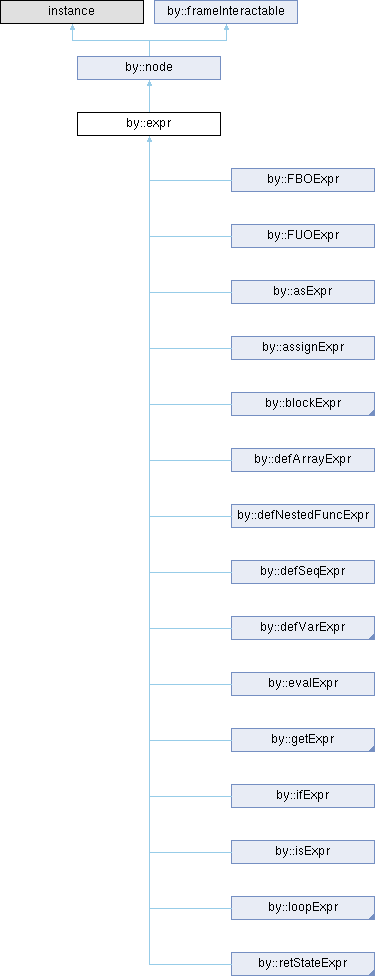
All expression types inherit from expr:
- Literal expressions - nInt, nStr, nBool, etc.
- Operator expressions - FBOExpr (binary), FUOExpr (unary)
- Access expressions - getExpr, evalExpr
- Assignment expressions - assignExpr, defVarExpr, defPropExpr
- Control flow expressions - ifExpr, forExpr, whileExpr, retExpr
- Container expressions - defArrayExpr, defSeqExpr
- Type expressions - asExpr, isExpr
Evaluation Without Arguments
Unlike functions, expressions evaluate without taking arguments. The prioritize() method ensures expressions can only be evaluated with an empty argument list. Evaluation happens through eval() which computes and returns the expression's value.
Source Location
expr maintains source location information via getSrc() for error reporting and debugging. This allows the interpreter to report exactly where in the source code an expression appears when errors occur.
Member Function Documentation
◆ getSrc()
◆ isImpli()
◆ prioritize()
eval of expr class get treated like 'evaluate' in byeol. it should not take any arguments to eval
Implements by::node.
Reimplemented in by::retExpr.
◆ subs()
The documentation for this class was generated from the following file:
- /home/runner/work/byeol/byeol/module/core/ast/expr.hpp