Function or object evaluation arguments. More...
#include <args.hpp>
Public Member Functions | |
| args (const narr &rhs) | |
| args (const baseObj *me) | |
| args (const baseObj *me, const narr &rhs) | |
| args (const me &rhs) | |
| const me & | setMe (const node &me) const |
| Sets the "me" object (context) for these arguments. | |
| const me & | setMe (const node *me) const BY_SIDE_FUNC(me |
| node * | getMe () const |
| std::string | toStr () const |
| tmay< me > | evalAll (const params &ps) const |
| Evaluates all arguments against a given set of parameters. | |
| tmay< me > | evalAll (const params *it) const BY_SIDE_FUNC(evalAll) |
 Public Member Functions inherited from by::tnarr< node > Public Member Functions inherited from by::tnarr< node > | |
| tnarr (const Es &... elems) | |
| tnarr (const me &rhs) | |
| me & | operator= (const me &rhs)=default |
| node & | operator[] (nidx n) override |
| ncnt | len () const override |
| nbool | in (nidx n) const override |
| node * | get (nidx n) override |
| nbool | set (const iter &at, const node &new1) override |
| nbool | set (nidx n, const node &new1) override |
| nbool | add (const iter &e, const node &new1) override |
| nbool | add (nidx n, const node &new1) override |
| void | add (const iter &here, const iter &from, const iter &to) override |
| nbool | del (const iter &from, const iter &end) override |
| nbool | del (const iter &it) override |
| nbool | del (nidx n) override |
| void | rel () override |
| clonable * | clone () const override |
| void | onCloneDeep (const clonable &from) override |
| std::string | asStr () const |
| Public Member Functions inherited from by::instance | |
| instance (id newId) | |
| instance (const me &rhs) | |
| me & | operator= (const me &rhs)=default |
| void * | operator new (size_t sz) noexcept |
| void | operator delete (void *pt, size_t sz) noexcept |
| virtual id | getId () const |
| virtual nbool | isHeap () const |
| Checks if this instance is allocated on the heap. | |
| const life * | getBindTag () const |
| Returns a pointer to the associated life object for reference counting. | |
| Public Member Functions inherited from by::typeProvidable | |
| nbool | operator== (const me &rhs) const |
| nbool | operator!= (const me &rhs) const |
| virtual const type & | getType () const =0 |
| nbool | isSub (const type &it) const |
| nbool | isSub (const type *it) const BY_SIDE_FUNC(isSub) |
| nbool | isSub (const me &it) const |
| nbool | isSub (const me *it) const BY_SIDE_FUNC(isSub) |
| nbool | isSuper (const type &it) const |
| nbool | isSuper (const type *it) const BY_SIDE_FUNC(isSuper) |
| nbool | isSuper (const me &it) const |
| nbool | isSuper (const me *it) const BY_SIDE_FUNC(isSuper) |
| template<typename T > | |
| nint | isSub () const |
| template<typename T > | |
| nint | isSuper () const |
| template<typename T > | |
| T * | cast () |
| template<typename T > | |
| const T * | cast () const BY_CONST_FUNC(cast< T >()) virtual void *cast(const type &to) |
| Safe cast to target type using type hierarchy information. | |
| const void * | cast (const type &to) const BY_CONST_FUNC(cast(to)) void *cast(const type *it) BY_SIDE_FUNC(cast) |
| Public Member Functions inherited from by::clonable | |
| virtual me * | cloneDeep () const |
| virtual void | onCloneDeep (const me &from) |
| Public Member Functions inherited from by::tucontainable< T, R, RSquare > | |
| nbool | in (const T &it) const |
| nbool | in (const T *it) const BY_SIDE_FUNC(in) |
| nbool | in (std::function< nbool(const T &)> l) const |
| template<typename T1 > | |
| nbool | in (std::function< nbool(const T1 &)> l) const |
| nbool | isEmpty () const |
| template<typename T1 > | |
| std::conditional_t< _IS_POINTER, T1 *, tmay< T1 > > | get (std::function< nbool(const T1 &)> l) |
| std::conditional_t< _IS_POINTER, R, tmay< R > > | get (std::function< nbool(const T &)> l) |
| template<typename T1 > | |
| void | each (std::function< nbool(T1 &)> l) |
| void | each (std::function< nbool(T &)> l) |
| virtual iter | end () const |
| virtual iter | rend () const |
| virtual iter | last () const |
| iter | iterate (ncnt step) const |
| iter | iterate (const T &it) const |
| iter | riterate (ncnt step) const |
| iter | riterate (const T &it) const |
| virtual nbool | set (const iter &at, const T &new1)=0 |
| virtual nbool | set (const iter &at, const T *new1) BY_SIDE_FUNC(new1 |
| virtual nbool | set (at, *new1) |
| virtual nbool | add (const iter &at, const T &new1)=0 |
| nbool | add (const iter &at, const T *new1) BY_SIDE_FUNC(new1 |
| nbool | add (at, *new1) |
| nbool | add (std::initializer_list< const T * > elems) |
| nbool | add (const T &new1) |
| nbool | add (const T *it) BY_SIDE_FUNC(add) |
| virtual void | add (const iter &here, const iter &from, const iter &to)=0 |
| void | add (const iter &from, const iter &to) |
| void | add (const iter &here, me &rhs) |
| void | add (const me &rhs) |
| void | add (const me *rhs) BY_SIDE_FUNC(rhs |
| void add | void ()) |
| template<typename E > | |
| ncnt | add (const typename tucontainable< E >::iter &from, const typename tucontainable< E >::iter &to) |
| template<typename E > | |
| ncnt | add (const tucontainable< E > &rhs) |
| template<typename K , typename V > | |
| ncnt | add (const tbicontainable< K, V > &rhs) |
| nbool | del () |
| nbool | del (const T &it) |
| nbool | del (const T *it) BY_SIDE_FUNC(del) |
| virtual nbool | del (const iter &it)=0 |
| virtual nbool | del (const iter &from, const iter &end)=0 |
| nbool | del (const me &rhs) |
| nbool | del (const me *rhs) BY_SIDE_FUNC(rhs |
| Public Member Functions inherited from by::tarrayable< T, R, RSquare > | |
| const RSquare | operator[] (nidx n) const BY_CONST_FUNC(operator[](n)) virtual nbool in(nidx n) const =0 |
| const R | get (nidx n) const BY_CONST_FUNC(get(n)) virtual nbool set(nidx n |
| nbool | set (nidx n, const T *new1) BY_SIDE_FUNC(new1 |
| nbool | set (n, *new1) |
| virtual nbool | add (nidx n, const T &new1)=0 |
| nbool | add (nidx n, const T *new1) BY_SIDE_FUNC(new1 |
| nbool | add (n, *new1) |
Public Attributes | |
| const me setMe | me |
| const me setMe * | this |
| Public Attributes inherited from by::tucontainable< T, R, RSquare > | |
| template<typename T1 > | |
| std::conditional_t< _IS_POINTER, const T1 *, tmay< T1 > > get(std::function< nbool(const T1 &)> l) const std tnarr< T, strTactic | getAll )(std::function< nbool(const T &)> l) const |
| template<typename T1 > | |
| void each(std::function< nbool(const T1 &)> l) const BY_CONST_FUNC(each(l)) void each(std ite | rbegin )() const |
| virtual nbool | false |
| nbool | false |
| void add | rhs |
| nbool del | rhs |
| nbool del | false |
| Public Attributes inherited from by::tarrayable< T, R, RSquare > | |
| const R const T & | new1 = 0 |
| nbool | false |
Additional Inherited Members | |
| Public Types inherited from by::tnarr< node > | |
| typedef tstr< node, strTactic > | wrap |
| typedef super::iter | iter |
| typedef super::iteration | iteration |
| Static Public Member Functions inherited from by::instance | |
| static vault & | getVault () |
| Protected Member Functions inherited from by::tnarr< node > | |
| iteration * | _onMakeIteration (ncnt step, nbool isReversed) const override |
| Protected Member Functions inherited from by::instance | |
| nbool | _setId (id new1) |
| Static Protected Member Functions inherited from by::instance | |
| static instancer * | _getMgr () |
Detailed Description
Function or object evaluation arguments.
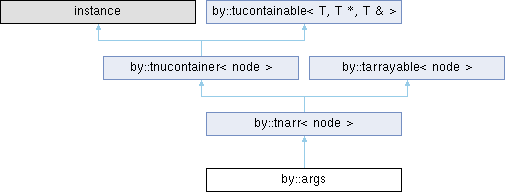
Represents arguments passed for eval() of functions or objects. Inherits from narr, so all narr APIs can be used.
Me Object
args is characterized by including a me object when passed. For example, with functions, the function fundamentally cannot know from which runtime object the eval() request came. Unlike some other languages, it doesn't create a hidden thisptr in args. Through separate setMe(), functions or properties using args can know from which object these args were passed.
Note that baseObj calls setMe(this) to place itself in args when eval(name, args) is called.
Member Function Documentation
◆ evalAll()
Evaluates all arguments against a given set of parameters.
This is an important step in function/method invocation, ensuring that the provided arguments match the expected parameters.
- Parameters
-
ps The parameters to evaluate the arguments against.
- Returns
- A tmay containing an
argsobject with evaluated arguments on success, or an empty tmay if evaluation fails.
◆ setMe()
Sets the "me" object (context) for these arguments.
This method is const because the _me member is mutable, allowing the context to be set even for const argument instances.
- Parameters
-
me The noderepresenting the "me" (context) object.
- Returns
- A const reference to this
argsinstance.
◆ toStr()
| std::string by::args::toStr | ( | ) | const |
- Remarks
- in order to call this func, you must have prepared thread and frames.
The documentation for this class was generated from the following file:
- /home/runner/work/byeol/byeol/module/core/ast/args.hpp