Automatic pack loading slot 더 자세히 ...
#include <autoslot.hpp>
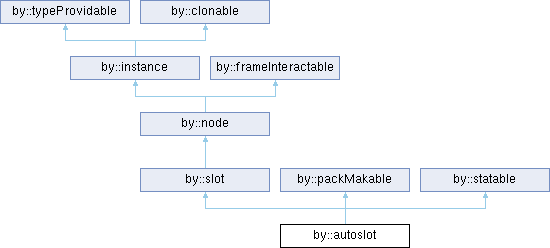
Public 멤버 함수 | |
| state | getState () const override |
| void | setState (state new1) override |
| obj & | getPack () override |
Retrieves the top-level object (obj) of this pack. | |
| void | rel () override |
 by::slot(으)로부터 상속된 Public 멤버 함수 by::slot(으)로부터 상속된 Public 멤버 함수 | |
| manifest & | getManifest () |
| const manifest & | getManifest () const |
| nbool | isValid () const |
| const obj & | getPack () const BY_CONST_FUNC(getPack()) void rel() override |
| void | addDependent (me &dependent) |
| Adds a dependent slot to this slot. | |
| void | addDependent (me *it) BY_SIDE_FUNC(addDependent) const tnarr< me > &getDependents() const |
| scope & | subs () override |
| priorType | prioritize (const args &a) const override |
| str | eval (const args &a) override |
| str | infer () const override |
| by::node(으)로부터 상속된 Public 멤버 함수 | |
| me & | operator[] (const std::string &name) |
| const me & | operator[] (const std::string &name) const BY_CONST_FUNC(operator[](name)) |
| me & | operator[] (const std::string *it) |
| const me & | operator[] (const std::string *it) const BY_CONST_FUNC(operator[](it)) |
| me & | operator[] (const nchar *name) |
| const me & | operator[] (const nchar *name) const BY_CONST_FUNC(operator[](name)) |
| nbool | in (const node &elem) const |
| nbool | in (const node *elem) const |
| const scope & | subs () const BY_CONST_FUNC(subs()) virtual tstr< nbicontainer > mySubs() const |
| Returns a tstr to a container of immediate sub-nodes (excluding inherited or chained ones). | |
| const node * | promote (const node &it) const |
| const node * | promote (const node *it) const BY_SIDE_FUNC(promote) |
| template<typename T > | |
| T * | sub (std::function< nbool(const std::string &, const T &)> l) |
| template<typename T > | |
| const T * | sub (std::function< nbool(const std::string &, const T &)> l) const BY_CONST_FUNC(sub< T >(l)) template< typename T |
| template<typename T = me> | |
| const T * | sub () const BY_CONST_FUNC(sub< T >()) template< typename T |
| template<typename T = me> | |
| T * | sub (const std::string *it) BY_SIDE_FUNC(sub) |
| template<typename T = me> | |
| const T * | sub (const std::string &name) const BY_CONST_FUNC(sub< T >(name)) template< typename T |
| template<typename T = me> | |
| T * | sub (const std::string *name, const args &a) BY_SIDE_FUNC(name |
| template<typename T = me> | |
| const T * | sub (const std::string &name, const args &a) const BY_CONST_FUNC(sub< T >(name |
| template<typename T = me> | |
| const T a const T * | sub (const std::string *name, const args &a) const BY_CONST_FUNC(sub< T >(name |
| template<typename T > | |
| const T a const T a tnarr< T, strTactic > | subAll (std::function< nbool(const std::string &, const T &)> l) const |
| template<typename T = me> | |
| tnarr< T, strTactic > | subAll () const |
| template<typename T = me> | |
| tpriorities< T > | subAll (const std::string &name) const |
| template<typename T = me> | |
| tpriorities< T > | subAll (const std::string *it) const BY_SIDE_FUNC(subAll< T >) template< typename T |
| template<typename T = me> | |
| tpriorities< T > | subAll (const std::string &name, const args &a) const |
| template<typename T = me> | |
| tpriorities< T > | subAll (const std::string *name, const args *a) const BY_SIDE_FUNC(name |
| tpriorities< T > subAll< T > | tpriorities ()) |
| template<typename T = me> | |
| tpriorities< T > | subAll (const std::string *name, const args &a) const BY_SIDE_FUNC(name |
| tpriorities< T > subAll< T > | tpriorities ()) |
| bool | canEval (const args &a) const |
| priorType | prioritize (const args *it) const BY_SIDE_FUNC(it |
| str | eval (const args *it) BY_SIDE_FUNC(eval) |
| str | eval (const std::string &name, const args &a) |
| str | eval (const std::string &name, const args *a) BY_SIDE_FUNC(a |
| str | eval (name, a) |
| str | str ()) |
| str | eval (const std::string *name, const args &a) BY_SIDE_FUNC(name |
| str eval | str ()) |
| str | eval (const std::string *name, const args *a) BY_SIDE_FUNC(name &&a |
| str eval | str ()) |
| str | eval (const std::string &name) |
| str | eval (const std::string *it) BY_SIDE_FUNC(eval) |
| str | eval () |
| template<typename T > | |
| nbool | is () const |
| nbool | is (const typeProvidable &to) const |
| nbool | is (const typeProvidable *it) const BY_SIDE_FUNC(is) |
| nbool | is (const type &to) const |
| nbool | is (const type *it) const BY_SIDE_FUNC(is) |
| template<typename T > | |
| tstr< T > | as () const |
| str | as (const typeProvidable &to) const |
| str | as (const typeProvidable *it) const BY_SIDE_FUNC(as) |
| str | as (const type &to) const |
| str | as (const type *it) const BY_SIDE_FUNC(as) |
| template<typename T > | |
| nbool | isImpli () const |
| virtual nbool | isImpli (const type &to) const |
| nbool | isImpli (const typeProvidable &to) const |
| nbool | isImpli (const typeProvidable *it) const BY_SIDE_FUNC(isImpli) |
| template<typename T > | |
| tstr< T > | asImpli () const |
| virtual str | asImpli (const type &to) const |
| str | asImpli (const typeProvidable &to) const |
| str | asImpli (const typeProvidable *it) const BY_SIDE_FUNC(asImpli) |
| virtual const src & | getSrc () const |
| virtual nbool | isComplete () const |
| virtual void | accept (const visitInfo &i, visitor &v) |
| void | inFrame (const bicontainable *args) const override |
| void | outFrame () const override |
| virtual const modifier & | getModifier () const |
| virtual void | inFrame (const bicontainable *args) const=0 |
| void | inFrame () const |
| virtual void | outFrame () const=0 |
| by::instance(으)로부터 상속된 Public 멤버 함수 | |
| instance (id newId) | |
| instance (const me &rhs) | |
| me & | operator= (const me &rhs)=default |
| void * | operator new (size_t sz) noexcept |
| void | operator delete (void *pt, size_t sz) noexcept |
| virtual id | getId () const |
| virtual nbool | isHeap () const |
| Checks if this instance is allocated on the heap. | |
| const life * | getBindTag () const |
| Returns a pointer to the associated life object for reference counting. | |
| by::typeProvidable(으)로부터 상속된 Public 멤버 함수 | |
| nbool | operator== (const me &rhs) const |
| nbool | operator!= (const me &rhs) const |
| virtual const type & | getType () const =0 |
| nbool | isSub (const type &it) const |
| nbool | isSub (const type *it) const BY_SIDE_FUNC(isSub) |
| nbool | isSub (const me &it) const |
| nbool | isSub (const me *it) const BY_SIDE_FUNC(isSub) |
| nbool | isSuper (const type &it) const |
| nbool | isSuper (const type *it) const BY_SIDE_FUNC(isSuper) |
| nbool | isSuper (const me &it) const |
| nbool | isSuper (const me *it) const BY_SIDE_FUNC(isSuper) |
| template<typename T > | |
| nint | isSub () const |
| template<typename T > | |
| nint | isSuper () const |
| template<typename T > | |
| T * | cast () |
| template<typename T > | |
| const T * | cast () const BY_CONST_FUNC(cast< T >()) virtual void *cast(const type &to) |
| Safe cast to target type using type hierarchy information | |
| const void * | cast (const type &to) const BY_CONST_FUNC(cast(to)) void *cast(const type *it) BY_SIDE_FUNC(cast) |
| by::clonable(으)로부터 상속된 Public 멤버 함수 | |
| virtual me * | clone () const =0 |
| virtual me * | cloneDeep () const |
| virtual void | onCloneDeep (const me &from) |
| by::frameInteractable(으)로부터 상속된 Public 멤버 함수 | |
| void | inFrame () const |
Protected 멤버 함수 | |
| nbool | _invalidate () override |
| Protected virtual method to invalidate the slot. | |
| by::slot(으)로부터 상속된 Protected 멤버 함수 | |
| void | _setValid (nbool valid) |
| str | _onEvalSub (node &sub, const args &a) override |
| Protected virtual method for evaluating a sub-node. | |
| by::node(으)로부터 상속된 Protected 멤버 함수 | |
| virtual void | _setSrc (const src &s) |
| void | _setSrc (const src *it) BY_SIDE_FUNC(_setSrc) |
| by::instance(으)로부터 상속된 Protected 멤버 함수 | |
| nbool | _setId (id new1) |
추가로 상속된 멤버들 | |
| by::instance(으)로부터 상속된 정적 Public 멤버 함수 | |
| static vault & | getVault () |
| by::node(으)로부터 상속된 Public 속성 | |
| T sub | name |
| T sub | nullptr |
| tpriorities< T > subAll< T > | name |
| priorType prioritize | it |
| priorType prioritize | NO_MATCH |
| str eval | name |
| by::instance(으)로부터 상속된 정적 Protected 멤버 함수 | |
| static instancer * | _getMgr () |
| by::slot(으)로부터 상속된 Protected 속성 | |
| tstr< obj > | _pak |
상세한 설명
Automatic pack loading slot
Inherits from slot, so see the slot class first if unfamiliar with it.
The byeol language lazily and dynamically loads packs. autoslot implements this feature. When slotLoader finds a pack file, it creates appropriate packLoading objects and places them in autoslot. Later, when accessing autoslot to retrieve contained symbols, packLoading operates lazily to load symbols from the file.
See slotLoader and packLoading for details.
Multiple packLoadings
packLoading can be retrieved from the native environment (dll or so files) or from the byeol runtime environment (.byeol files). Or both may exist in a single pack. Therefore, autoslot doesn't hold just one packLoading but handles them as an array.
Dynamic Verification and Dependency Issues
We cannot simply assume all packs are verified and flawless and just load them. Sometimes packs need to be verified again to ensure correctness, so some autoslots must parse or verify before loading symbols. The problem is that packs very frequently depend on other packs. If a dependent pack fails verification, that fact must propagate so all dependent packs also become unusable. This is solved by an algorithm controlling the four states described below.
autoslot State
Has four states total with the following loading pipeline flow:
- slot creation: slotLoader creates slot objects and adds them to the system. At this time, dependencies between slots are also recorded.
- RELEASED: Initial state, occupies no memory. Most unused slots belong here.
- PARSED: When autoslot is accessed, code is parsed for actual use. If parsing is unnecessary (optimized pack distribution or native pack), skips directly to LINKED state.
- VERIFIED: After parsing, code integrity is verified. If verification fails, isValid is set to false.
- LINKED: If verification failed, propagates that failure to all dependents referencing it.
Recursive Loading
Packs depending on other packs is very common. Because autoslot operates lazily, loading one slot may access another autoslot, causing that autoslot to also recursively enter the loading sequence. This checks for duplicate initialization or incomplete pipeline traversal.
RAII
autoslot points to the _pack object defined in slot. This object contains symbols loaded from the external pack file. Since autoslot is responsible for pack loading through packLoading, it's also responsible for symbol and pack destruction. Using RAII, when the autoslot object is destroyed, all symbols are removed first, then the packLoading object is also removed to perform operations like closing so files. See packLoading for details.
is required to run an autoslot
when you try to load pack by accessing subs() of autoslot instance, it processes loading and access to errReport when exception occurs during that procedure. basically, accessing to subs() of autoslot happen when you eval your AST. which means, you're required to prepare a thread. so autoslot will use the errReport instance in current thread::getEx().
- Remarks
- this doesn't mean that a thread is needed when running a slotLoader that creates autoslots.
멤버 함수 문서화
◆ _invalidate()
|
overrideprotectedvirtual |
Protected virtual method to invalidate the slot.
This method is typically called internally to mark the slot as invalid, making it unusable for further operations.
- 반환값
- true if the slot was successfully invalidated, false otherwise.
by::slot(으)로부터 재구현되었습니다.
◆ getPack()
|
overridevirtual |
Retrieves the top-level object (obj) of this pack.
- 반환값
- A reference to the pack's
obj.
by::slot(으)로부터 재구현되었습니다.
◆ getState()
|
overridevirtual |
by::statable를 구현.
◆ rel()
|
overridevirtual |
◆ setState()
|
overridevirtual |
by::statable를 구현.
이 클래스에 대한 문서화 페이지는 다음의 파일로부터 생성되었습니다.:
- /home/runner/work/byeol/byeol/module/core/ast/autoslot.hpp