Generalized binding class for managing instance lifecycles. More...
#include <binder.hpp>
Public Member Functions | |
| binder (const type &type, bindTacticable &tactic) | |
| Constructs a binder with a specific type and binding tactic. | |
| binder (const me &rhs) | |
| instance * | operator-> () |
| Dereference operator to access bound instance. | |
| const instance * | operator-> () const BY_CONST_FUNC(operator->()) instance &operator*() |
| const instance & | operator* () const BY_CONST_FUNC(operator*()) me &operator |
| Assigns another binder's bound instance to this binder. | |
| id | getItsId () const |
| Retrieves the unique ID of the instance currently bound by this binder. | |
| nbool | isBind () const override |
| void | rel () override |
| nbool | canBind (const type &it) const override |
| Checks if given type can be bound to this binder. | |
| nbool | bind (const instance &it) override |
| Binds instance to this binder with reference counting. | |
| instance * | get () |
| const instance * | get () const BY_CONST_FUNC(get()) template< typename E > E *get() |
| template<typename E > | |
| const E * | get () const BY_CONST_FUNC(get< E >()) const type &getType() const override |
| void * | cast (const type &to) override |
| nbool | canBind (const T &it) const |
| nbool | canBind (const T *it) const BY_SIDE_FUNC(canBind) |
| virtual nbool | canBind (const type &it) const=0 |
| nbool | canBind (const type *it) const BY_SIDE_FUNC(canBind) |
| virtual nbool | bind (const T &it) |
| nbool | bind (const T *it) |
| Bind to instance pointer. | |
| template<typename T > | |
| T * | cast () |
| template<typename T > | |
| const T * | cast () const BY_CONST_FUNC(cast< T >()) virtual void *cast(const type &to) |
| Safe cast to target type using type hierarchy information. | |
| const void * | cast (const type &to) const BY_CONST_FUNC(cast(to)) void *cast(const type *it) BY_SIDE_FUNC(cast) |
 Public Member Functions inherited from by::typeProvidable Public Member Functions inherited from by::typeProvidable | |
| nbool | operator== (const me &rhs) const |
| nbool | operator!= (const me &rhs) const |
| virtual const type & | getType () const =0 |
| nbool | isSub (const type &it) const |
| nbool | isSub (const type *it) const BY_SIDE_FUNC(isSub) |
| nbool | isSub (const me &it) const |
| nbool | isSub (const me *it) const BY_SIDE_FUNC(isSub) |
| nbool | isSuper (const type &it) const |
| nbool | isSuper (const type *it) const BY_SIDE_FUNC(isSuper) |
| nbool | isSuper (const me &it) const |
| nbool | isSuper (const me *it) const BY_SIDE_FUNC(isSuper) |
| template<typename T > | |
| nint | isSub () const |
| template<typename T > | |
| nint | isSuper () const |
| template<typename T > | |
| T * | cast () |
| template<typename T > | |
| const T * | cast () const BY_CONST_FUNC(cast< T >()) virtual void *cast(const type &to) |
| Safe cast to target type using type hierarchy information. | |
| const void * | cast (const type &to) const BY_CONST_FUNC(cast(to)) void *cast(const type *it) BY_SIDE_FUNC(cast) |
| Public Member Functions inherited from by::tbindable< instance > | |
| operator nbool () const | |
| nbool | bind (const instance *it) |
| Bind to instance pointer. | |
| nbool | canBind (const instance &it) const |
| nbool | canBind (const instance *it) const BY_SIDE_FUNC(canBind) |
| nbool | canBind (const type *it) const BY_SIDE_FUNC(canBind) |
Protected Member Functions | |
| nbool | _assign (const binder &rhs) |
| Assigns binder from another binder. | |
| nbool | _onSame (const typeProvidable &rhs) const override |
| Checks if two typeProvidable objects are same instance. | |
| life * | _getBindTag () const |
| Retrieves life object associated with bound instance. | |
Protected Attributes | |
| id | _itsId |
| const type * | _type |
| bindTacticable * | _tactic |
Friends | |
| struct | ::binderTest |
Detailed Description
Generalized binding class for managing instance lifecycles.
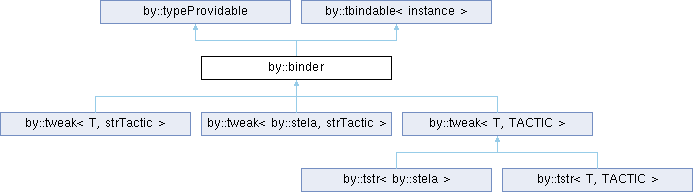
Can bind any object inheriting from instance. Uses reference counting to properly destroy objects at appropriate times. Similar to std::weak_ptr and std::shared_ptr, with tweak handling weak pointers and tstr handling strong pointers.
Usage
Basic usage with bind(), isBind(), and get():
More concise real-world usage:
Why not use shared_ptr?
Several advantages over shared_ptr:
- Reference counting block attached to instance itself
- Provides ADT (Abstract Data Type)
- tstr and tweak share same binder base, enabling generic logic: }
- tstr and tweak share same binder base, enabling generic logic:
- Dynamic type checking
- Remarks
- Abstract nature binder is abstract, so cannot create objects. Only meaningful for generic logic using already created tstr or tweak binders.
Custom memory pool
Ultimate goal of memlite is lightweight C++ memory management for byeol runtime environment. Requires GC and additional memory management, implying custom memory pool and instance lifecycle management. All instance allocation starts with instancer.
Performance improvements
shared_ptr's algorithm stores reference counting info on heap. Using faster custom memory pool instead of heap and optimizing binding speed provides performance gains. Binding is one of the hotspots consuming most performance in byeol.
Additional information
shared_ptr creates objects on heap for reference counting. memlite uses watcher to lend empty life objects from pre-allocated memory, using them as reference counting space for instances. If GC features are added later, instances may require additional lifecycle information. Unlike shared_ptr, managing each instance's lifecycle information internally allows appropriate handling of such requirements.
Constructor & Destructor Documentation
◆ binder()
| by::binder::binder | ( | const type & | type, |
| bindTacticable & | tactic ) |
Constructs a binder with a specific type and binding tactic.
- Parameters
-
type The type of the instance this binder will manage. tactic The binding tactic (e.g., strong or weak) to use for reference counting.
Member Function Documentation
◆ _assign()
Assigns binder from another binder.
- Returns
- true on success, false on failure
- Note
- Handles reference counting via tactic when copying bindings
◆ _getBindTag()
|
protected |
Retrieves life object associated with bound instance.
- Returns
- Pointer to life object, or nullptr if not bound
- Note
- Internal accessor for reference counting operations
◆ _onSame()
|
overrideprotected |
Checks if two typeProvidable objects are same instance.
- Returns
- true if same object, false otherwise
- Note
- Overrides typeProvidable for binder-specific equality
◆ bind() [1/2]
Binds instance to this binder with reference counting.
- Returns
- true on success, false if type mismatch or binding fails
- Note
- Increases reference count. Type must match via canBind() check.
Reimplemented from by::tbindable< instance >.
◆ bind() [2/2]
| nbool by::tbindable< T >::bind | ( | const T * | it | ) |
Bind to instance pointer.
binder will loose previous binding instance whether given parameter it isn't nullptr or not.
◆ canBind() [1/2]
Checks if given type can be bound to this binder.
- Returns
- true if type matches or is subtype of binder's type, false otherwise
- Note
- Uses meta module for dynamic type checking
Implements by::tbindable< instance >.
◆ canBind() [2/2]
Implements by::tbindable< instance >.
◆ cast()
Safe cast to target type using type hierarchy information.
- Returns
- Pointer to object if cast is valid, nullptr otherwise
- Note
- Uses O(1) tier algorithm instead of slow dynamic_cast
◆ getItsId()
| id by::binder::getItsId | ( | ) | const |
Retrieves the unique ID of the instance currently bound by this binder.
- Returns
- The ID of the bound instance. Returns an invalid ID if no instance is bound.
◆ isBind()
|
overridevirtual |
Implements by::tbindable< instance >.
◆ operator*()
Assigns another binder's bound instance to this binder.
This operator handles the transfer of binding, ensuring proper reference counting adjustments for both the source and target binders.
- Parameters
-
rhs The binder to assign from.
- Returns
- A reference to this binder.
◆ operator->()
| instance * by::binder::operator-> | ( | ) |
Dereference operator to access bound instance.
This follows the same policy as tmay and stl. that is, if the binder does not bind any instances and tries to dereference them with get() or operator*(), it will behave as UB. this is likely to crash.
◆ rel()
|
overridevirtual |
Implements by::tbindable< instance >.
The documentation for this class was generated from the following files:
- /home/runner/work/stela/stela/module/memlite/binder/binder.hpp
- /home/runner/work/stela/stela/module/memlite/binder/binder.cpp