AST verifier for semantic analysis. More...
#include <verifier.hpp>
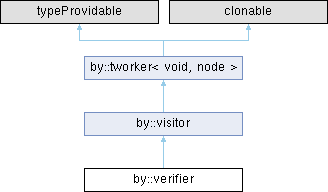
Public Member Functions | |
| void | onLeave (const visitInfo &i, node &me, nbool) override |
| void | onLeave (const visitInfo &i, asExpr &me, nbool) override |
| void | onLeave (const visitInfo &i, isExpr &me, nbool) override |
| void | onLeave (const visitInfo &i, assignExpr &me, nbool) override |
| nbool | onVisit (const visitInfo &i, blockExpr &me, nbool) override |
| void | onLeave (const visitInfo &i, blockExpr &me, nbool) override |
| void | onLeave (const visitInfo &i, defVarExpr &me, nbool) override |
| void | onLeave (const visitInfo &i, defPropExpr &me, nbool) override |
| void | onLeave (const visitInfo &i, defAssignExpr &me, nbool) override |
| void | onLeave (const visitInfo &i, defSeqExpr &me, nbool) override |
| void | onLeave (const visitInfo &i, defArrayExpr &me, nbool) override |
| void | onLeave (const visitInfo &i, defNestedFuncExpr &me, nbool) override |
| void | onLeave (const visitInfo &i, FBOExpr &me, nbool) override |
| void | onLeave (const visitInfo &i, FUOExpr &me, nbool) override |
| void | onLeave (const visitInfo &i, getExpr &me, nbool) override |
| void | onLeave (const visitInfo &i, retExpr &me, nbool) override |
| void | onLeave (const visitInfo &i, evalExpr &me, nbool) override |
| void | onTraverse (evalExpr &me, node &subject) override |
| nbool | onVisit (const visitInfo &i, func &me, nbool) override |
| void | onLeave (const visitInfo &i, func &me, nbool) override |
| nbool | onVisit (const visitInfo &i, closure &me, nbool) override |
| void | onLeave (const visitInfo &i, closure &me, nbool) override |
| nbool | onVisit (const visitInfo &i, ctor &me, nbool) override |
| void | onLeave (const visitInfo &i, ctor &me, nbool) override |
| nbool | onVisit (const visitInfo &i, baseObj &me, nbool) override |
| void | onLeave (const visitInfo &i, baseObj &me, nbool) override |
| nbool | onVisit (const visitInfo &i, genericOrigin &me, nbool) override |
| void | onLeave (const visitInfo &i, genericOrigin &me, nbool) override |
| nbool | onVisit (const visitInfo &i, forExpr &me, nbool) override |
| void | onLeave (const visitInfo &i, forExpr &me, nbool) override |
| nbool | onVisit (const visitInfo &i, whileExpr &me, nbool) override |
| void | onLeave (const visitInfo &i, breakExpr &me, nbool) override |
| void | onLeave (const visitInfo &i, nextExpr &me, nbool) override |
| nbool | onVisit (const visitInfo &i, ifExpr &me, nbool) override |
| void | onLeave (const visitInfo &i, ifExpr &me, nbool) override |
 Public Member Functions inherited from by::visitor Public Member Functions inherited from by::visitor | |
| visitor (nbool isReturnable) | |
| void | setReturnable (nbool isReturnable) |
| nbool | isReturnable () const |
| virtual void | visit (const visitInfo &i, node &me) |
| virtual nbool | onVisit (const visitInfo &i, node &me, nbool alreadyVisited) |
| virtual void | onTraverse (const visitInfo &i, node &me) |
| virtual void | onTraverse (const visitInfo &i, asExpr &a) |
| virtual void | onTraverse (const visitInfo &i, assignExpr &a) |
| virtual void | onTraverse (const visitInfo &i, blockExpr &b) |
| virtual void | onTraverse (const visitInfo &i, defVarExpr &d) |
| virtual void | onTraverse (const visitInfo &i, FBOExpr &f) |
| virtual void | onTraverse (const visitInfo &i, getExpr &e) |
| virtual void | onTraverse (const visitInfo &i, retExpr &b) |
| virtual void | onTraverse (const visitInfo &i, evalExpr &e) |
| virtual void | onTraverse (const visitInfo &i, func &f) |
| virtual void | onTraverse (const visitInfo &i, frame &f) |
| virtual void | onTraverse (const visitInfo &i, forExpr &f) |
| virtual void | onTraverse (const visitInfo &i, retStateExpr &r) |
| virtual void | onTraverse (const visitInfo &i, ifExpr &f) |
| virtual void | onTraverse (const visitInfo &i, whileExpr &w) |
| virtual void | onTraverse (const visitInfo &i, defArrayExpr &d) |
| virtual void | onTraverse (const visitInfo &i, defNestedFuncExpr &e) |
| virtual void | onTraverse (const visitInfo &i, genericOrigin &g) |
| virtual void | onTraverse (const visitInfo &i, obj &o) |
| Public Member Functions inherited from by::tworker< void, node > | |
| tworker (const errReport &rpt) | |
| errReport & | getReport () |
| const errReport & | getReport () const BY_CONST_FUNC(getReport()) me &setReport(errReport &rpt) |
| me & | setFlag (nint newFlag) |
| me & | addFlag (nint flag) |
| me & | delFlag (nint clear) |
| nbool | isFlag (nint flag) const |
| nint | getFlag () const |
| me & | setTask (const node &root) |
| me & | setTask (const node *it) BY_SIDE_FUNC(it |
| node * | getTask () |
| const node * | getTask () const BY_CONST_FUNC(getTask()) virtual void rel() |
| void | work () |
| const area & | getArea () const BY_CONST_FUNC(_getArea()) nbool isOk() const |
| Public Member Functions inherited from by::typeProvidable | |
| nbool | operator== (const me &rhs) const |
| nbool | operator!= (const me &rhs) const |
| virtual const type & | getType () const =0 |
| nbool | isSub (const type &it) const |
| nbool | isSub (const type *it) const BY_SIDE_FUNC(isSub) |
| nbool | isSub (const me &it) const |
| nbool | isSub (const me *it) const BY_SIDE_FUNC(isSub) |
| nbool | isSuper (const type &it) const |
| nbool | isSuper (const type *it) const BY_SIDE_FUNC(isSuper) |
| nbool | isSuper (const me &it) const |
| nbool | isSuper (const me *it) const BY_SIDE_FUNC(isSuper) |
| template<typename T > | |
| nint | isSub () const |
| template<typename T > | |
| nint | isSuper () const |
| template<typename T > | |
| T * | cast () |
| template<typename T > | |
| const T * | cast () const BY_CONST_FUNC(cast< T >()) virtual void *cast(const type &to) |
| Safe cast to target type using type hierarchy information. | |
| const void * | cast (const type &to) const BY_CONST_FUNC(cast(to)) void *cast(const type *it) BY_SIDE_FUNC(cast) |
| Public Member Functions inherited from by::clonable | |
| virtual me * | clone () const =0 |
| virtual me * | cloneDeep () const |
| virtual void | onCloneDeep (const me &from) |
Protected Member Functions | |
| void | _prepare () override |
| Protected virtual method for preparation before starting the work. | |
| void | _onEndWork () override |
| Protected virtual method called after the work is completed. | |
| Protected Member Functions inherited from by::visitor | |
| void | _onWork () override |
| void | _prepare () override |
| Protected virtual method for preparation before starting the work. | |
| Protected Member Functions inherited from by::tworker< void, node > | |
| void | _report (baseErr *e) |
| area & | _getArea () |
| void | _onEndErrReport (const errReport &rpt) const |
Friends | |
| struct | ::verifierTest |
Additional Inherited Members | |
| Public Types inherited from by::tworker< void, node > | |
| enum | logFlag |
| Public Attributes inherited from by::tworker< void, node > | |
| me setTask | it |
| me setTask * | this |
Detailed Description
AST verifier for semantic analysis.
Handles code verification based on visitor. Although the byeol language has an interpreter structure, the language itself uses strong typing and produces errors in advance as if executing compilation. verifier implements the core of that functionality. It checks for errors before executing the final AST created by parser and expander.
Understanding Difficulty
verifier is an advanced class even within the core module that uses various modules, so you need to know about several classes beforehand. It's probably one of the classes that will only be understood at the very last stage in this project. You need to know not only node and visitor but also expr and WHEN macros to understand it easily.
Visitor Based
Since onTraverse is filled in by visitor, verifier only defines what should be done during onVisit and onLeave.
eval and infer
Program execution ultimately consists of each node's eval(), but verifier is not interested in executed runtime values. It's only interested in type matching such as whether execution is possible and whether the result of a specified expression is implicitly convertible with the defined property's type. node's infer() performs type inference functionality, returning the result type as an origin object without knowing the value when executed. It's faster than eval() because it doesn't compute values. Now you might sense it, but verifier focuses on using infer() rather than eval().
As in the above example, infer() is mainly used instead of eval().
Many Lines of Code File
verifier is one of the files with the most LOC. At this time, the code is largely classified into 3 types.
- Preliminary work for verification
- Actual verification logic using WHEN macros
- Detailed logging for each stage
Detailed Stage Logging
visitor can only have 1 onVisit() function per type. However, verifier usually has 2 or more verification cases that need to be checked when given one type. So if not careful, one onVisit() function becomes mixed with multiple verification logics making it difficult to distinguish. Detailed stage logging helps with this, playing the role of leaving logs about what verification logic will be performed on the object being verified. For example, the _STEP macro automatically counts which stage within that function it is and shows the log.
Verification Using WHEN Macros
verifier is a class with many verification codes like if (!check) return res;. So verifier inevitably has numerous WHEN macros.
verifier vs starter
starter directly executes the program. verifier only performs verification. The biggest difference between them is that when starter executes expressions with eval(), verifier only gets type information with infer(). However, there are some tasks that verifier must perform identically to starter.
- First, using frameInteract. To find out if a type exists and is currently accessible, the obj scope or func scope must actually be registered in the frame. Usually if inFrame() is called for a specific object in onVisit(), outFrame() will be called for the same object in onLeave().
- Actually define properties. Although the value is empty, the property itself must be defined to check whether the property is duplicate or if a non-existent property is being accessed.
- Actually create generic classes. Only then can generic class verification be possible.
Member Function Documentation
◆ _onEndWork()
|
overrideprotectedvirtual |
Protected virtual method called after the work is completed.
This hook allows derived classes to perform any necessary cleanup or finalization after _onWork() has finished.
Reimplemented from by::tworker< void, node >.
◆ _prepare()
|
overrideprotectedvirtual |
Protected virtual method for preparation before starting the work.
This hook allows derived classes to perform any necessary setup or initialization before _onWork() is invoked.
Reimplemented from by::tworker< void, node >.
◆ onLeave()
Reimplemented from by::visitor.
◆ onTraverse()
Reimplemented from by::visitor.
The documentation for this class was generated from the following file:
- /home/runner/work/byeol/byeol/module/core/worker/visitor/verifier.hpp