Loading...
Searching...
No Matches
by::tres< T, R > Class Template Reference
Template result container with typed error information. More...
#include <tres.hpp>
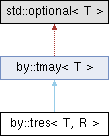
Inheritance diagram for by::tres< T, R >:
Public Member Functions | |
| tres (const T &value) | |
| tres (const R &value) | |
| R & | getErr () |
| Gets the contained error. | |
| const R & | getErr () const BY_CONST_FUNC(getErr()) void rel() override |
| Releases/clears both the contained value and the error, making the instance empty. | |
| void | set (const T &arg) override |
| Sets the contained value and clears any existing error. | |
| void | setErr (const R &arg) |
| Sets the contained error and clears any existing value. | |
 Public Member Functions inherited from by::tmay< T > Public Member Functions inherited from by::tmay< T > | |
| tmay (const T &value) | |
| tmay (const tmedium< T > &value) | |
| T * | operator-> () |
| const T * | operator-> () const BY_CONST_FUNC(operator->()) |
| T & | operator* () |
| const T & | operator* () const BY_CONST_FUNC(operator*()) |
| operator T& () | |
| operator const T & () const | |
| operator nbool () const | |
| nbool | has () const |
| T * | get () |
| Gets the contained value. | |
| const T * | get () const BY_CONST_FUNC(get()) virtual void rel() |
| Releases/clears the contained value, making the instance empty. | |
Detailed Description
Template result container with typed error information.
Identical to tmay but allows defining a custom error type when errors occur. While tmay<T> can only indicate whether an error occurred or not, tres<T, R> can provide detailed error information of type R when an error occurs.
Usage
Example comparing tmay and tres:
// Using tmay - can only tell if error occurred:
if(!result1.has()) {
// Know there's an error, but not what kind
}
// Using tres - can get error details:
if(!result2.has()) {
}
Common error types include std::string for error messages, or custom error enums for categorized error handling.
Member Function Documentation
◆ getErr()
Gets the contained error.
- Warning
- Should only be called when has() returns false. Accessing when has() is true results in undefined behavior.
- Returns
- A reference to the contained error object.
◆ set()
Sets the contained value and clears any existing error.
Reimplemented from by::tmay< T >.
The documentation for this class was generated from the following file:
- _deps/indep_dep-src/module/indep/helper/tres.hpp