Collection of memory chunks for scalable allocation. More...
#include <chunks.hpp>
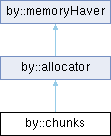
Public Member Functions | |
| chunks (ncnt blkbyte=0) | |
| chunk & | operator[] (nidx n) |
| const chunk & | operator[] (nidx n) const BY_CONST_FUNC(operator[](n)) |
| chunk & | operator[] (const instance &it) |
| const chunk & | operator[] (const instance &it) const BY_CONST_FUNC(operator[](it)) |
| chunk * | get (nidx n) |
| chunk * | get (const instance &it) |
| chunk * | get (const instance *it) BY_SIDE_FUNC(get) |
| const chunk * | get (nidx n) const BY_CONST_FUNC(get(n)) const chunk *get(const instance &it) const BY_CONST_FUNC(get(it)) const chunk *get(const instance *it) const BY_CONST_FUNC(get(it)) void *new 1() override |
| nbool | del (void *pt, ncnt sz) override |
| virtual nbool | resize (ncnt new1) |
| nbool | has (const instance &it) const override |
| Checks if any of the managed chunks contain the memory allocated for the given instance. | |
| ncnt | len () const override |
| ncnt | size () const override |
| nbool | rel () override |
 Public Member Functions inherited from by::allocator Public Member Functions inherited from by::allocator | |
| allocator (ncnt blksize=1) | |
| virtual void * | new1 ()=0 |
| ncnt | getBlkSize () const |
| Public Member Functions inherited from by::memoryHaver | |
| nbool | has (const instance *it) const BY_SIDE_FUNC(has) |
| nbool | isFull () const |
| nbool | isCapable () const |
Additional Inherited Members |
Detailed Description
Collection of memory chunks for scalable allocation.
Manages multiple chunk instances. Since chunk uses only fixed-size memory created at initialization, chunks adds/removes multiple chunks to manage memory dynamically.
chunks also provides only fixed memory
Since chunks adds or removes chunks, and each chunk cell uses only fixed size, chunks can also only allocate fixed-size memory.
Coordination with pool
The first to receive memory requests is pool class. When pool receives a memory size to allocate, it lazily retrieves a chunks instance capable of handling that memory size and requests new1(). chunks::new1() finds a chunk capable of allocating memory, and if none exists, creates an additional chunk.
Available chunk search algorithm
The most recently memory-allocated chunk has the highest probability of being able to allocate additionally. Member variable _s holds the index of the most recently allocated chunk. If _chunks[_s] has no available memory, increment _s. Like a circular array, _chunks' end connects to its beginning. If _s loops back to its pre-traversal value and still no available memory exists, the entire chunks has no available memory, so enters resize().
- Remarks
- Cannot use vector Obviously, vector is managed on heap, so shouldn't use vector while making a custom memory pool. Planned for future modification.
Member Function Documentation
◆ del()
Implements by::allocator.
◆ has()
Checks if any of the managed chunks contain the memory allocated for the given instance.
- Parameters
-
it The instance whose memory location is to be checked.
- Returns
- true if the instance's memory is within any of this chunks' child chunks, false otherwise.
Implements by::memoryHaver.
◆ len()
|
overridevirtual |
Implements by::memoryHaver.
◆ rel()
|
overridevirtual |
Implements by::memoryHaver.
◆ resize()
- Remarks
- chunk can resize its data. but can't persist whole memory allocated before, it's a kind of memory flashing and can't give a way for accessing it. at outside, ptr for them should be daggled.
◆ size()
|
overridevirtual |
Implements by::memoryHaver.
The documentation for this class was generated from the following file:
- /home/runner/work/stela/stela/module/memlite/pool/chunks.hpp