|
| const ntype & | getType () const override |
| |
| scope & | subs () override |
| |
| priorType | prioritize (const args &a) const override |
| |
| const modifier & | getModifier () const override |
| |
| str | run (const args &a) override |
| |
| const baseObj & | getOrigin () const override |
| |
|
const baseFunc & | getFunc () const |
| |
| params & | getParams () override |
| |
| const node * | getRet () const override |
| |
| const src & | getSrc () const override |
| |
|
| baseFunc (const modifier &mod) |
| |
|
const params & | getParams () const BY_CONST_FUNC(getParams()) |
| |
|
me & | operator[] (const std::string &name) |
| |
|
const me & | operator[] (const std::string &name) const BY_CONST_FUNC(operator[](name)) |
| |
|
me & | operator[] (const std::string *it) |
| |
|
const me & | operator[] (const std::string *it) const BY_CONST_FUNC(operator[](it)) |
| |
|
me & | operator[] (const nchar *name) |
| |
|
const me & | operator[] (const nchar *name) const BY_CONST_FUNC(operator[](name)) |
| |
|
nbool | in (const node &elem) const |
| |
|
nbool | in (const node *elem) const |
| |
|
const scope & | subs () const BY_CONST_FUNC(subs()) virtual tstr< nbicontainer > mySubs() const |
| |
| const node * | deduce (const node &it) const |
| |
|
const node * | deduce (const node *it) const BY_SIDE_FUNC(deduce) |
| |
|
template<typename T > |
| T * | sub (std::function< nbool(const std::string &, const T &)> l) |
| |
|
template<typename T > |
| const T * | sub (std::function< nbool(const std::string &, const T &)> l) const BY_CONST_FUNC(sub< T >(l)) template< typename T |
| |
|
template<typename T = me> |
| const T * | sub () const BY_CONST_FUNC(sub< T >()) template< typename T |
| |
|
template<typename T = me> |
| T * | sub (const std::string *it) BY_SIDE_FUNC(sub) |
| |
|
template<typename T = me> |
| const T * | sub (const std::string &name) const BY_CONST_FUNC(sub< T >(name)) template< typename T |
| |
|
template<typename T = me> |
| T * | sub (const std::string *name, const args &a) BY_SIDE_FUNC(name |
| |
|
template<typename T = me> |
| const T * | sub (const std::string &name, const args &a) const BY_CONST_FUNC(sub< T >(name |
| |
|
template<typename T = me> |
| const T a const T * | sub (const std::string *name, const args &a) const BY_CONST_FUNC(sub< T >(name |
| |
|
template<typename T > |
| const T a const T a tnarr< T, strTactic > | subAll (std::function< nbool(const std::string &, const T &)> l) const |
| |
|
template<typename T = me> |
| tnarr< T, strTactic > | subAll () const |
| |
|
template<typename T = me> |
| tpriorities< T > | subAll (const std::string &name) const |
| |
| template<typename T = me> |
| tpriorities< T > | subAll (const std::string *it) const BY_SIDE_FUNC(subAll< T >) template< typename T |
| |
|
template<typename T = me> |
| tpriorities< T > | subAll (const std::string &name, const args &a) const |
| |
|
template<typename T = me> |
| tpriorities< T > | subAll (const std::string *name, const args *a) const BY_SIDE_FUNC(name |
| |
|
tpriorities< T > subAll< T > | tpriorities ()) |
| |
|
template<typename T = me> |
| tpriorities< T > | subAll (const std::string *name, const args &a) const BY_SIDE_FUNC(name |
| |
|
tpriorities< T > subAll< T > | tpriorities ()) |
| |
|
bool | canRun (const args &a) const |
| |
|
priorType | prioritize (const args *it) const BY_SIDE_FUNC(it |
| |
|
str | run (const args *it) BY_SIDE_FUNC(run) |
| |
|
str | run (const std::string &name, const args &a) |
| |
|
str | run (const std::string &name, const args *a) BY_SIDE_FUNC(a |
| |
|
str | run (name, a) |
| |
|
str | str ()) |
| |
|
str | run (const std::string *name, const args &a) BY_SIDE_FUNC(name |
| |
|
str run | str ()) |
| |
|
str | run (const std::string *name, const args *a) BY_SIDE_FUNC(name &&a |
| |
|
str run | str ()) |
| |
|
str | run (const std::string &name) |
| |
|
str | run (const std::string *it) BY_SIDE_FUNC(run) |
| |
|
str | run () |
| |
| virtual void | rel () |
| |
|
template<typename T > |
| nbool | is () const |
| |
|
nbool | is (const typeProvidable &to) const |
| |
|
nbool | is (const typeProvidable *it) const BY_SIDE_FUNC(is) |
| |
|
nbool | is (const type &to) const |
| |
|
nbool | is (const type *it) const BY_SIDE_FUNC(is) |
| |
|
template<typename T > |
| tstr< T > | as () const |
| |
|
str | as (const typeProvidable &to) const |
| |
|
str | as (const typeProvidable *it) const BY_SIDE_FUNC(as) |
| |
|
str | as (const type &to) const |
| |
|
str | as (const type *it) const BY_SIDE_FUNC(as) |
| |
|
template<typename T > |
| nbool | isImpli () const |
| |
|
virtual nbool | isImpli (const type &to) const |
| |
|
nbool | isImpli (const typeProvidable &to) const |
| |
|
nbool | isImpli (const typeProvidable *it) const BY_SIDE_FUNC(isImpli) |
| |
|
template<typename T > |
| tstr< T > | asImpli () const |
| |
|
virtual str | asImpli (const type &to) const |
| |
|
str | asImpli (const typeProvidable &to) const |
| |
|
str | asImpli (const typeProvidable *it) const BY_SIDE_FUNC(asImpli) |
| |
| virtual nbool | isComplete () const |
| |
| virtual str | getEval () const |
| |
|
virtual void | accept (const visitInfo &i, visitor &v) |
| |
| void | inFrame (const bicontainable *args) const override |
| |
| void | outFrame () const override |
| |
| virtual void | inFrame (const bicontainable *args) const=0 |
| |
|
void | inFrame () const |
| |
| virtual void | outFrame () const=0 |
| |
|
| instance (id newId) |
| |
|
| instance (const me &rhs) |
| |
|
me & | operator= (const me &rhs)=default |
| |
|
void * | operator new (size_t sz) noexcept |
| |
|
void | operator delete (void *pt, size_t sz) noexcept |
| |
|
virtual id | getId () const |
| |
|
virtual nbool | isHeap () const |
| |
|
const bindTag * | getBindTag () const |
| |
|
nbool | operator== (const me &rhs) const |
| |
|
nbool | operator!= (const me &rhs) const |
| |
|
nbool | isSub (const type &it) const |
| |
|
nbool | isSub (const type *it) const BY_SIDE_FUNC(isSub) |
| |
|
nbool | isSub (const me &it) const |
| |
|
nbool | isSub (const me *it) const BY_SIDE_FUNC(isSub) |
| |
|
nbool | isSuper (const type &it) const |
| |
|
nbool | isSuper (const type *it) const BY_SIDE_FUNC(isSuper) |
| |
|
nbool | isSuper (const me &it) const |
| |
|
nbool | isSuper (const me *it) const BY_SIDE_FUNC(isSuper) |
| |
|
template<typename T > |
| nint | isSub () const |
| |
|
template<typename T > |
| nint | isSuper () const |
| |
|
template<typename T > |
| T * | cast () |
| |
|
template<typename T > |
| const T * | cast () const BY_CONST_FUNC(cast< T >()) virtual void *cast(const type &to) |
| |
|
const void * | cast (const type &to) const BY_CONST_FUNC(cast(to)) void *cast(const type *it) BY_SIDE_FUNC(cast) |
| |
|
virtual me * | clone () const =0 |
| |
|
virtual me * | cloneDeep () const |
| |
|
virtual void | onCloneDeep (const me &from) |
| |
|
void | inFrame () const |
| |
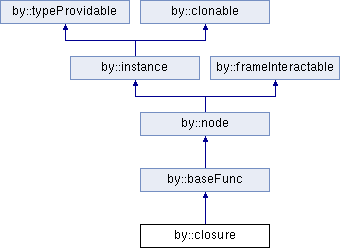
func closure with captured object scope
Proxy for @func with captured object scope for closures. When arguments are provided, object scope is replaced with captured scope.
- Note
- Allows carrying functions without needing to reference any object.
 Public Member Functions inherited from by::baseFunc